CASE STUDY · THIRD-PARTY LOGISTICS · CITIZEN DEVELOPMENT · NORTH AMERICA
Citizen Development Pipeline
North American 3PL Operator
2 plugins
Spec and Dev, published in the company's Claude Cowork marketplace
16 steps
Idempotent scaffold that resumes cleanly from any failure
First run
Six-module warehouse platform with 46,066 rows migrated
Near-zero
Marginal engineering time for each additional production app
Background
A North American third-party logistics operator runs warehouse operations across multiple verticals. Their operations team builds the tools they need in Claude. That works to get to the first version. It had not worked for getting those applications onto infrastructure Engineering could trust or maintain.
The gap between what a non-engineer could build and what a production application required was not a skills problem. It was an infrastructure problem. Every operator-built application started from scratch, landed outside the company's standard stack, and created a maintenance burden nobody had signed up for.
The Challenge
The company needed a way for non-engineers to ship production applications without creating that burden. Generic low-code platforms were not the answer. They produce applications that live outside source control, outside the company's hosting, and outside any review pattern Engineering already uses.
The requirement was tighter: operator-built applications needed to land on the company's standard stack, in the company's GitHub organization, under the company's Railway workspace, the first time, every time, without Engineering involvement in the build.
Solution
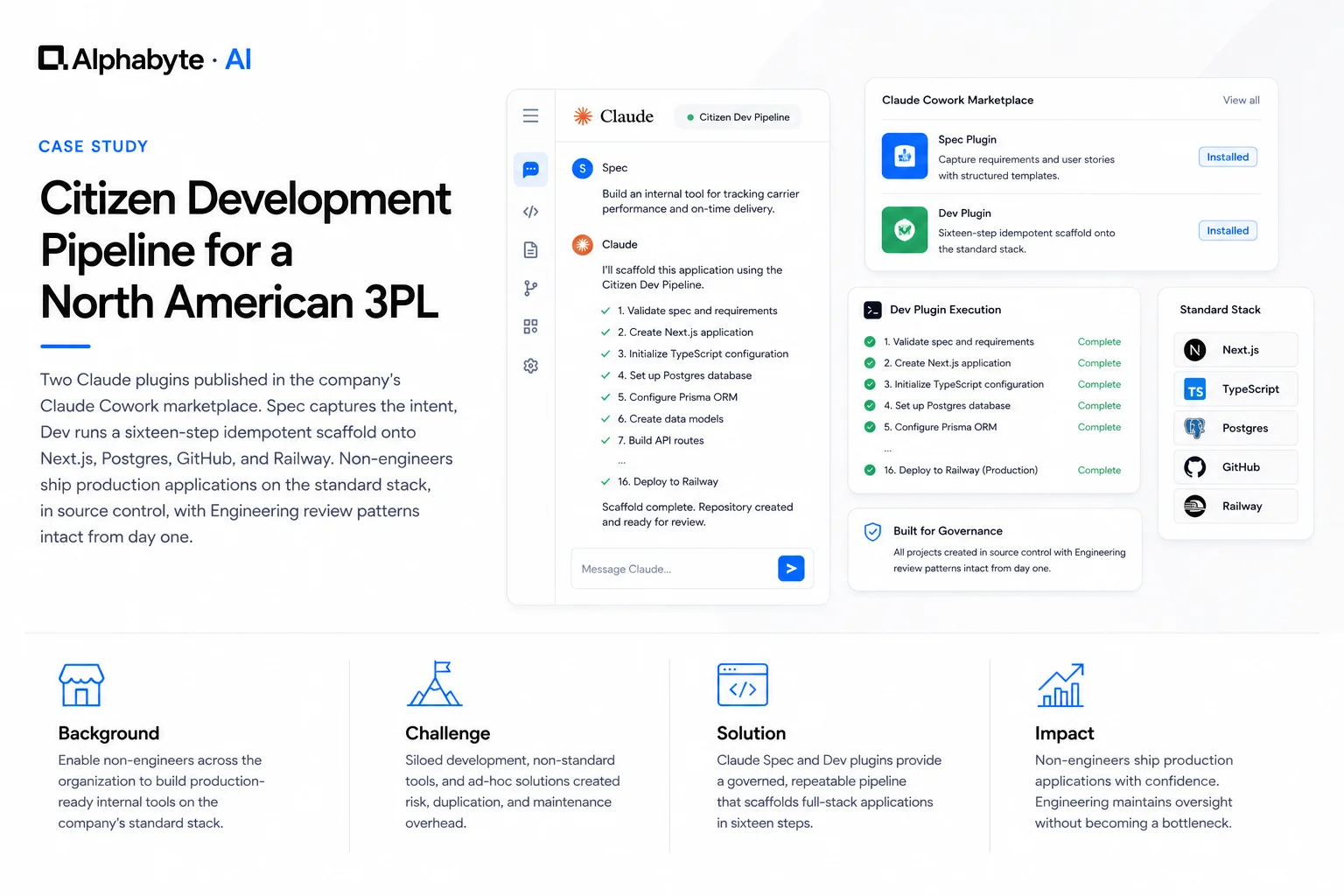
Alphabyte built a two-plugin citizen development pipeline, published in the company's Claude Cowork marketplace. The first run of the pipeline was the warehouse platform rebuild described in the companion case study.
The Spec plugin runs in a chat tab. A non-engineer describes the problem, the users, and the features in plain language. The plugin asks the questions, cross-references the company's existing GitHub organization for prior art, and produces a schema-validated specification document. The project slug is locked from the directory name: deterministic, not user chosen.
The Dev plugin runs in a development tab. The citizen developer says, "build this." The plugin reads the specification and runs a sixteen-step idempotent scaffold: a Next.js application on Node 20, optional authentication with NextAuth and bcrypt, optional Postgres with Prisma and a per-deploy migration hook, optional Resend email, a private GitHub repository under the company's organization, a Railway deploy with Postgres provisioned and the initial migration run, and a public domain. Each step probes filesystem and remote state, skips what is already done, and picks up cleanly from any failure point.
All subsequent development happens in natural-language conversation in the same tab. Dedicated skills handle moments that warrant structure: database schema changes and migrations, Railway deploy and log debugging, third-party API integration grounded in current documentation, the company's design language and tokens, project-memory conventions, and read-only access to the company's curated BigQuery mart layer.
Every application ships on the company's standard stack, into the company's GitHub organization, under the company's Railway workspace, with the same conventions and review patterns Engineering already uses. Shared credentials are auto-fetched cross-projects. Governance is inherited, not configured per application.
Marginal cost of the next operator-built production application is near zero in engineering time. Governance is inherited, not configured per app.
Results
The pipeline is in production and available to the full organization. Its first run shipped a six-module warehouse application with 46,066 rows of migrated production data.
Every application lands on the company's standard stack, in source control, with Engineering review patterns intact from day one. The marginal cost of the next operator-built production application is near zero in engineering time.
Want to explore what we could build for your operations?
45 minutes. No cost. No obligation.