CASE STUDY · THIRD-PARTY LOGISTICS · WAREHOUSE OPERATIONS · NORTH AMERICA
Operations-Critical Warehouse Platform Rebuild
North American 3PL Operator
6 weeks
Architecture lock to handover-ready production
46,066 rows
Migrated in a single transactional run
Zero downtime
On the legacy side during cutover
261 assets
Stranded photos recovered post-migration
Background
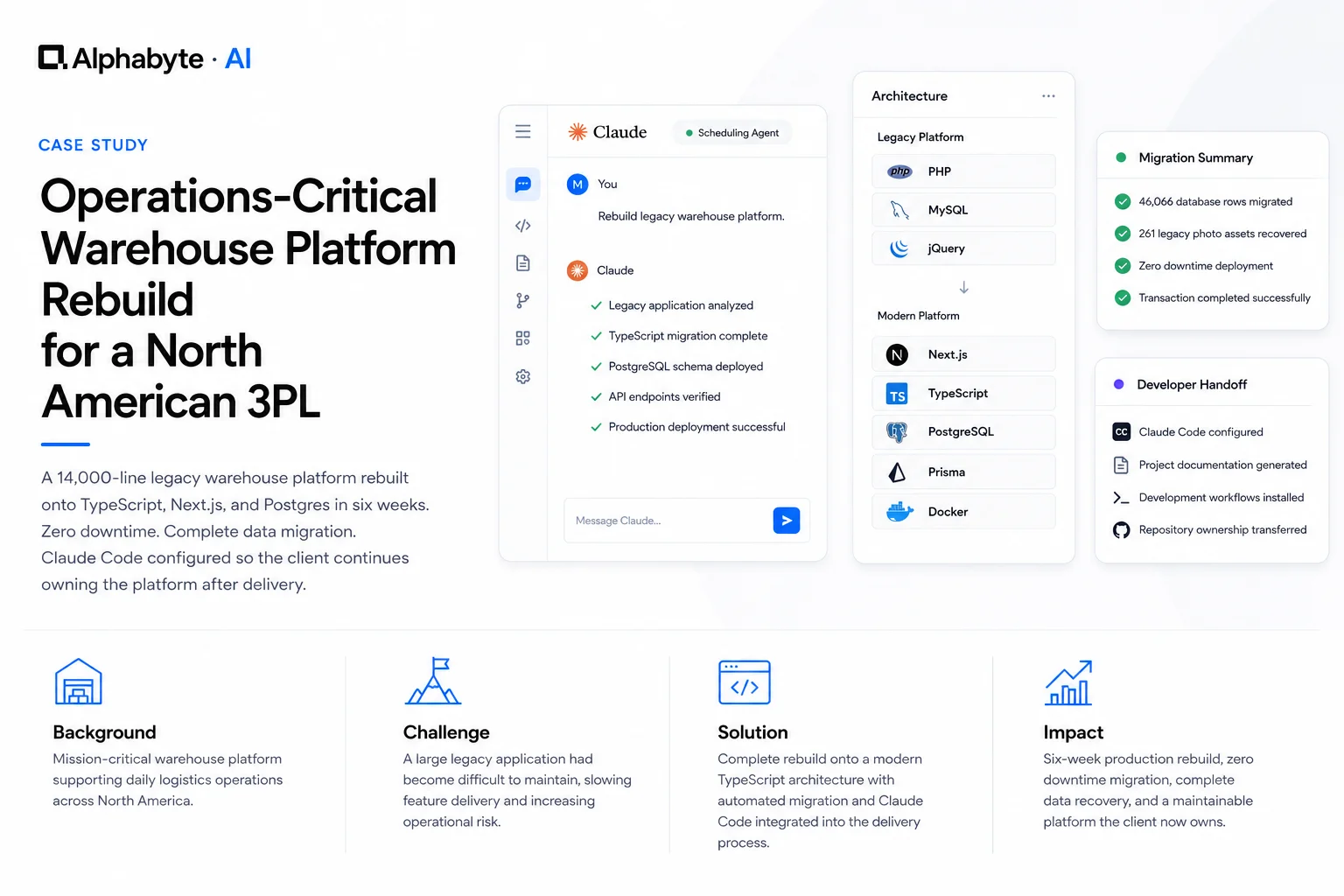
A North American third-party logistics operator runs a warehouse floor that moves high volumes of refurbished electronics daily. The platform their operations lead built herself, in a Claude chat, had become the system her team depended on for shipment verification, pick-and-pack, vendor reconciliation, and receive-and-triage. It worked. Warehouse staff used it every day.
The codebase behind it was a 14,000-line single HTML file. Python Flask on external hosting, outside the company's standard Node and Next.js stack. SQLite with JSON blobs in columns that should have been relational. Plaintext credentials in the database. Six undocumented data-repair endpoints baked into production. No tests, no CI, no review process.
The Challenge
Working production software and an unmaintainable codebase occupied the same system. The hard part was not the engineering. It was ownership. The only person who fully understood what the platform needed to do was the operations lead who built it, and any fix that took the application away from her would turn Engineering into a permanent bottleneck and slow the floor down.
Two obvious paths were both wrong. Cleaning it up in place would take months and change nothing structurally. Rebuilding it without the operations team would solve the code and break the thing that made it work. The real objective was to keep the right person in control of the application while moving it onto infrastructure Engineering could review and maintain.
Solution
Alphabyte rebuilt the platform as the first run of a company-wide citizen development pipeline, treating the engagement as a system rather than a one-off project.
Six operational modules were ported onto the new stack: Shipment Check with IMEI scanning and vendor CSV parsing across seven formats; Pick and Pack with operator-concurrent writes and a client-side label generator; vendor reconciliation with automated Slack and email alerts; Receive and Triage with scan-priority routing and contextual triage by device type; Settings and user management with full activity logging; and Reports and exports with PDF packing lists, CSV outputs, and vendor-specific Ship Advice panels.
The legacy application stayed live throughout. On migration day, 46,066 rows of production data were ported into the new Postgres database in a single transactional run with zero downtime on the legacy side. Legacy passwords were transparently rehashed to bcrypt on first login. A recovery pass then surfaced 261 of 440 stranded photo assets by joining on the content-addressable identifiers the legacy app had used.
The codebase was handed back to its owner with a complete Claude Code configuration. A root CLAUDE.md documented the stack, workflows, environment inventory, and hard rules. A committed project memory directory held the full specification, architecture document, every recorded decision with rationale, and the live backlog. Her Claude opens the project already oriented. She does not have to brief it. She continues iterating from the same chat interface she always used, now backed by a codebase Engineering can review.
The operations lead keeps control of the platform she built. Engineering gets a codebase it can review. The floor never noticed the cutover.
Results
Six weeks from architecture lock to handover-ready production. 46,066 rows migrated in a single transactional run with zero downtime on the legacy side. 261 stranded photo assets recovered post-migration, a set the client had written off.
The platform now runs on the company's standard stack, with the same hosting, source control, build gates, and review patterns as the rest of Engineering. Warehouse staff kept working through the cutover with no retraining, and the operations lead kept shipping features throughout.
She continues to own and evolve the platform, with full project memory committed alongside the code.
Want to explore what we could build for your operations?
45 minutes. No cost. No obligation.