
AI Readiness Scorecard: Score Your Company in 30 Minutes
A fast AI readiness scorecard: score your company from 1 to 5 on strategy, data, governance, skills, and culture. Find your weakest area in 30 minutes.

Adam Nameh
November 3, 2026 · 6 min read
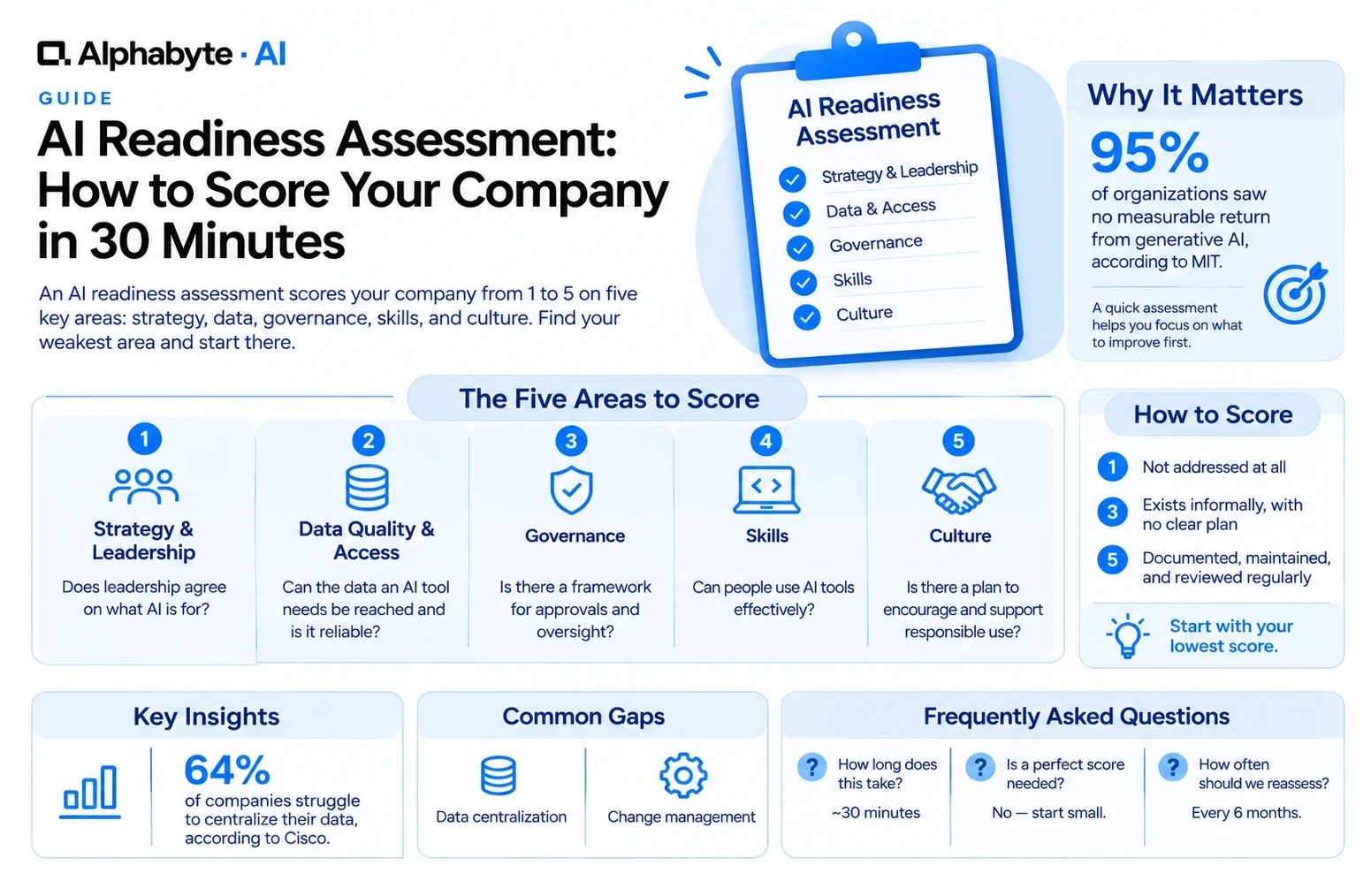
An AI readiness scorecard scores your company from 1 to 5 on five areas: strategy, data, governance, skills, and culture. Your lowest score shows where to start. A person who knows how the company uses AI today can complete it in about 30 minutes, with no outside help and no deck to build afterward.
The case for checking first, rather than picking a use case and hoping the organisation can support it, comes from MIT NANDA's 2025 report, The GenAI Divide. It found 95 percent of organisations saw no measurable return from generative AI. The authors call the findings preliminary, based on more than 300 public initiatives, 52 organisation interviews, and a survey of 153 leaders. Treat the figure as a signal rather than a precise rate, but the direction is hard to ignore: most AI investment is not failing because the technology does not work. It is failing because the organisation around it was not ready for it.
That is the gap this scorecard is built to catch before you spend a quarter finding it out the hard way. It will not tell you which AI project to build. It will tell you which part of the organisation would make any project you pick harder than it needs to be, which is usually the more useful answer at this stage.
The five areas to score
Readiness frameworks use different labels across the industry. Gartner's AI maturity assessment names seven pillars, including strategy, data, governance, and culture. The five areas below are our simplified version, built to be scored in under half an hour rather than researched over several weeks.
Strategy and leadership buy-in. Does leadership agree on what AI is for here, or is every team chasing a different use case with no shared definition of success?
Data quality and access. Can the data an AI tool would need actually be reached, and is it clean enough to trust once it is?
Governance. Is there a framework deciding what gets approved, or is every use case a one-off decision made by whoever asked first? Our AI governance framework guide gives you a four-part starting point for this area specifically.
Workforce skills. Can people use the tools they already have access to, past the first demo and into actual repeatable work?
Change management and culture. Is there a plan for getting people to change how they work, or only a tool rollout that assumes the change management will happen on its own?
How to score each area
This scoring method is our own. Score each area from 1 to 5.
A 1 means the area is not addressed at all. A 3 means it exists informally, handled by whoever happens to own it, with no documented plan. A 5 means it is documented, actively maintained, and reviewed on a set cadence.
Start with your lowest score, even if another area feels more exciting to fix. A company that scores a 5 on strategy and a 1 on data will not get more value from refining the strategy further. It will get more value from fixing the data gap that is quietly capping everything built on top of it.
Score the five areas independently before you try to average them into one number. A single blended score hides exactly the information you need: that one weak area, not a mediocre result everywhere, is usually what is actually holding a project back. Treat the lowest number as the finding, not the average.
For the data area, our sister site's data quality guide shows how to score your key fields in more depth than this five-point scale allows on its own.
Two assumptions that inflate your score
A February 2026 CIO.com article on the hidden cost of AI adoption points to two places where companies consistently overrate themselves.
Having data is different from having usable data. Historical data that is messy, unlabeled, or hard to reach is not ready because it technically exists somewhere. A system full of records nobody can export cleanly scores closer to a 2 than the 4 most teams assume by default.
A vendor tool leaves the internal work in place. Integration, access control, and workflow changes remain your job regardless of how capable the tool itself is. Buying the tool does not move your governance or skills score, and treating it as though it does is the most common way a scorecard ends up too generous.
Both assumptions push the same direction: toward a score that looks better on paper than the organisation actually performs in practice. A scorecard filled in optimistically is worse than not scoring at all, because it produces false confidence instead of an honest starting point.
Where companies score lowest
Cisco's AI Readiness Index 2025 surveyed more than 8,000 senior leaders in August 2025. It found 13 percent of organisations are fully ready for AI, a group Cisco calls Pacesetters. Sixty-four percent of respondents struggle to centralise their data. Ninety-one percent of Pacesetters have a change-management plan, against 35 percent across the survey as a whole.
Data centralisation and change management are the two gaps worth checking first, and the gap between those two numbers on change management is the more interesting one. It suggests the difference between a company that gets value from AI and one that does not has less to do with which tools it buys and more to do with whether anyone planned for how people would actually change how they work.
Run the five scores yourself this week, or talk to our team and we will walk through it with you.
Frequently Asked Questions
How long does this scorecard take?
About 30 minutes for someone who knows the company's AI use today, scoring all five areas.
Is this the same as your shadow AI self-check?
No. Our shadow AI guide finds out what employees already use without approval. This scorecard measures whether the company is ready to roll out AI formally.
What if we score low across the board?
That is not a reason to stop. Start with the single lowest-scoring area rather than trying to fix all five at once.
Do we need a perfect score before starting an AI project?
No. A 3 across the board is a workable starting point for a first, narrow project. A 1 in data quality or governance is the signal to fix that area first.
How often should we reassess?
Every six months, or sooner if the company adopts a new AI tool across several teams at once.
Does company size change what readiness looks like?
The five areas stay the same. The bar for a 5 in governance is lower for a 150-person company than for a 5,000-person one, because the structure needed grows with headcount.
Adam Nameh
Co-Founder, AI Practice. Adam Nameh is the Co-Founder of Alphabyte Solutions Inc., a Toronto-based data and AI consulting firm that has helped over 100 clients across North America turn complex data environments into actionable business intelligence. With a decade of hands-on experience in data architecture and platform design, Adam works directly with leadership teams to deliver practical AI and data solutions that drive real business outcomes.
View full profile →More from the blog
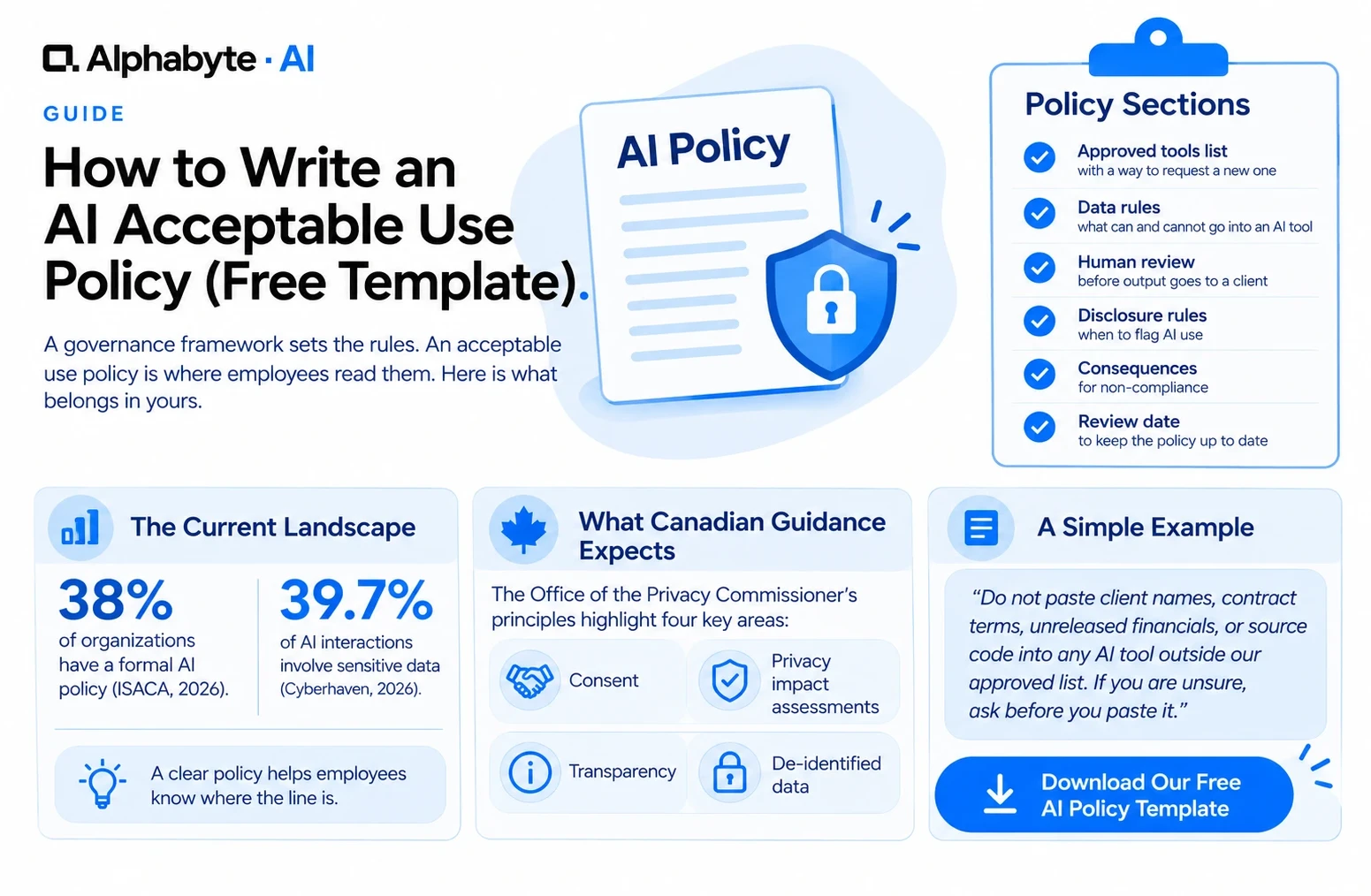
How to Write an AI Acceptable Use Policy (Free Template)
Use this AI policy template to write an acceptable use policy: the sections it needs, what Canadian privacy guidance expects, and a free download.
Read more →
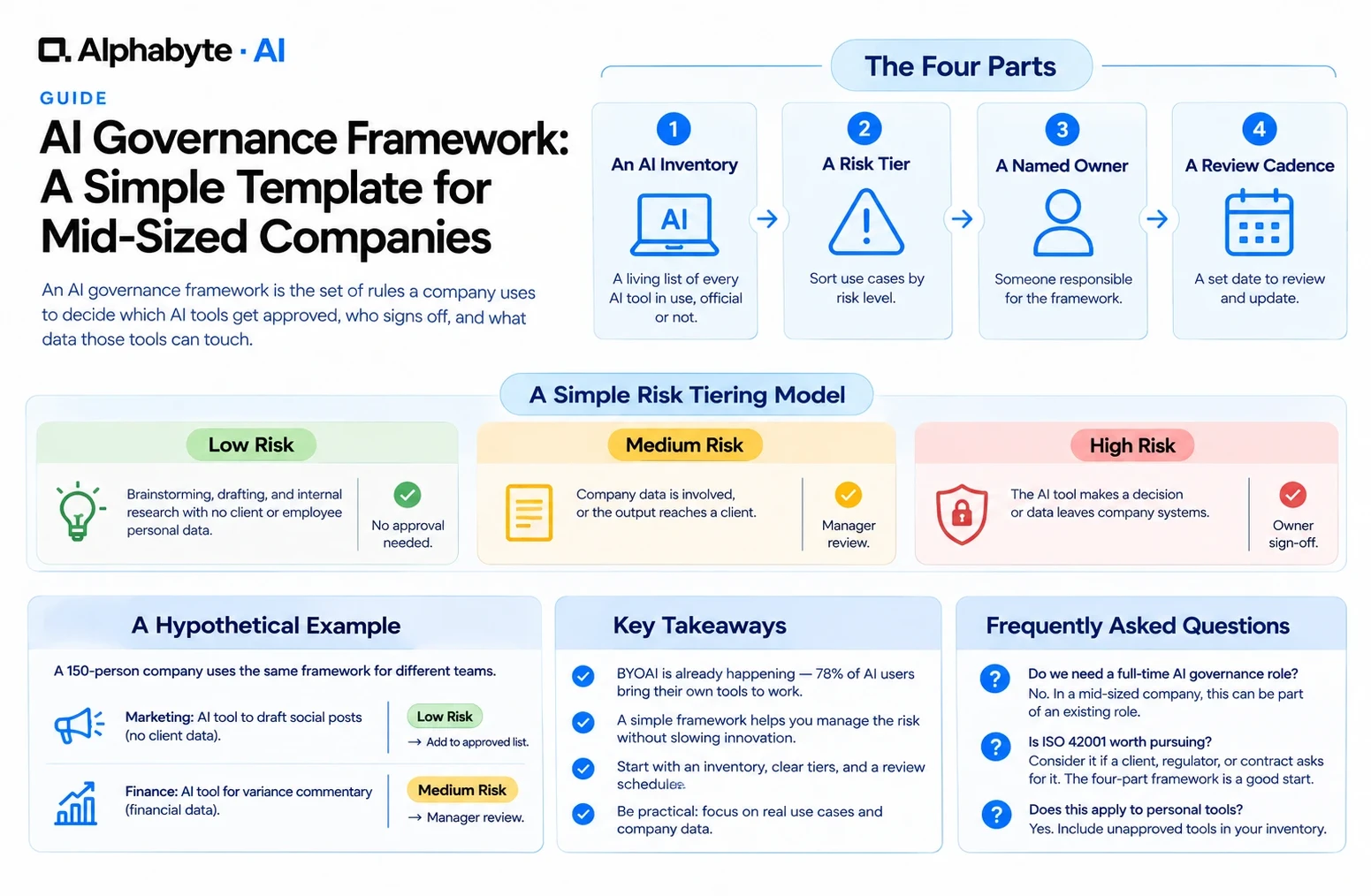
AI Governance Framework: A Simple Template for Mid-Sized Companies
A four-part AI governance framework for mid-sized companies: an inventory, risk tiers, a named owner, and a review cadence. Includes a three-tier risk model and a free one-page template.
Read more →
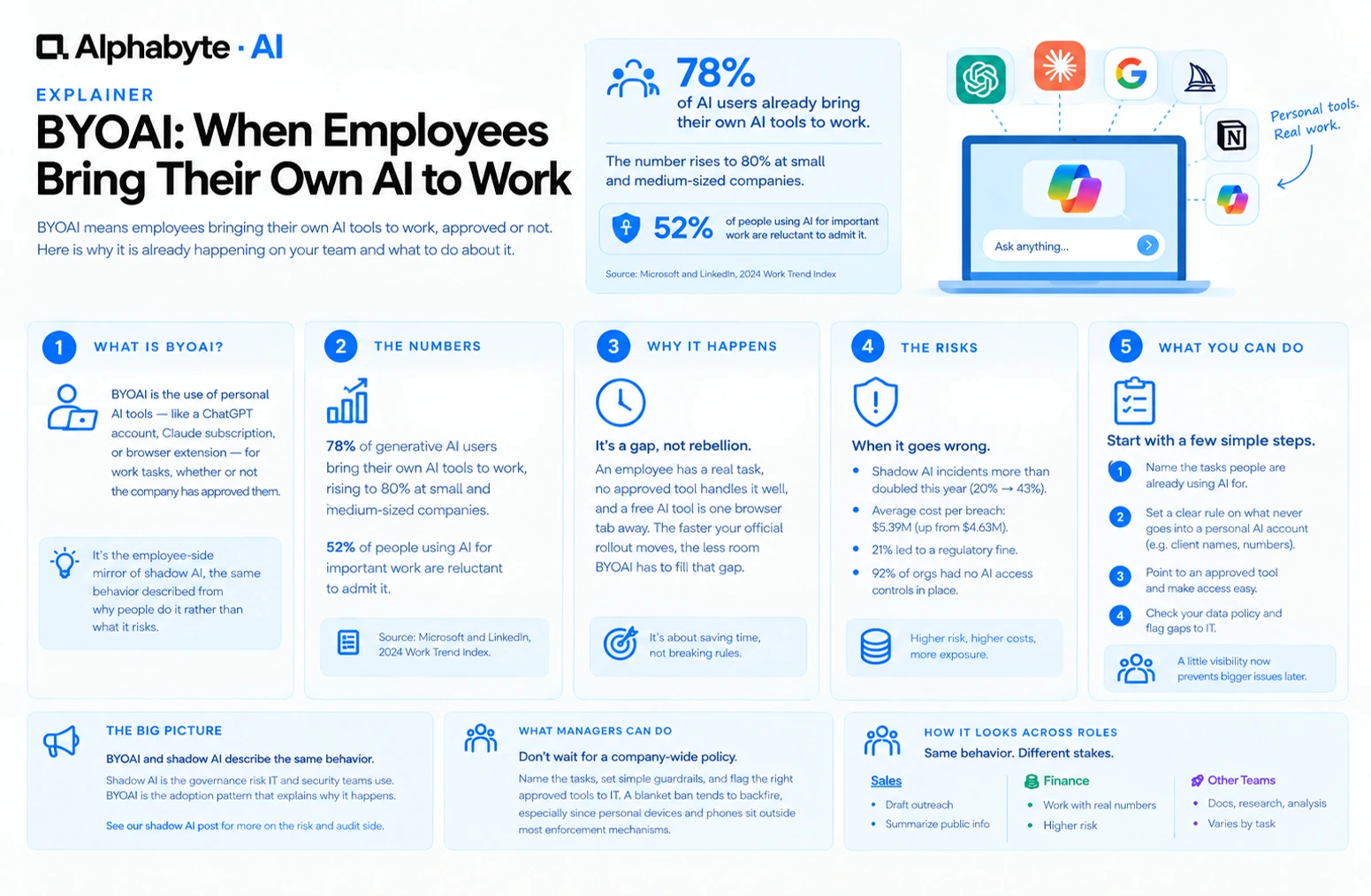
BYOAI: When Employees Bring Their Own AI to Work
78% of AI users already bring their own AI tools to work. BYOAI is not a future trend. It is your team's current reality, whether IT has caught up or not.
Read more →