BYOAI: When Employees Bring Their Own AI to Work
78% of AI users already bring their own AI tools to work. BYOAI is not a future trend. It is your team's current reality, whether IT has caught up or not.

Adam Nameh
October 6, 2026 · 10 min read
In This Article
- The numbers behind BYOAI
- Why employees do this instead of waiting
- A self-check for employees, not just IT
- What good BYOAI looks like
- What companies get wrong when responding to this
- What managers can do without waiting for a company policy
- How BYOAI differs across roles
- What success looks like a few months in
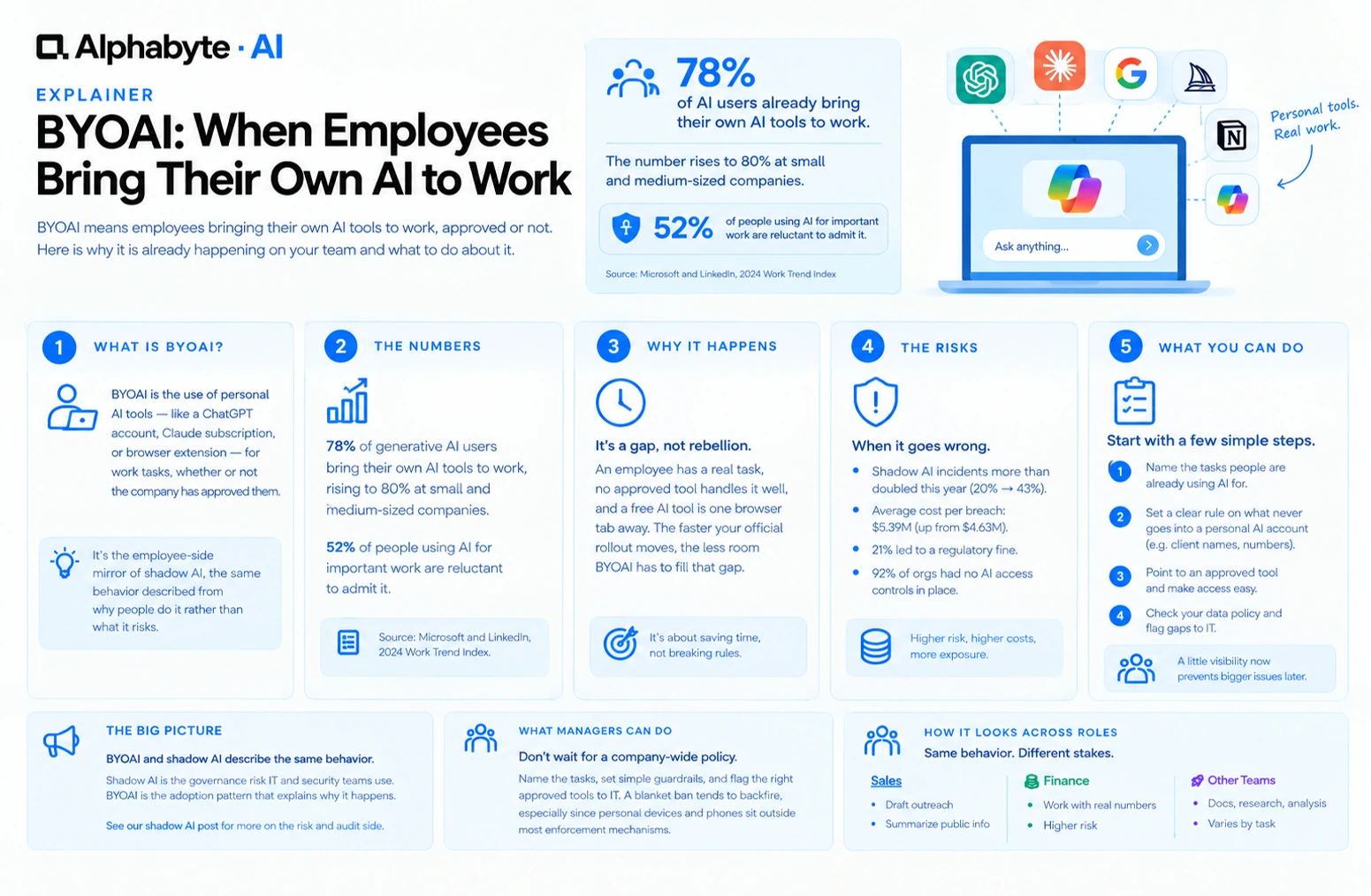
BYOAI, short for bring your own AI, describes employees using personal AI tools, a ChatGPT account, a Claude subscription, a browser extension, for work tasks, whether or not the company has approved them. It is the employee-side mirror of shadow AI, the same behavior described from why people do it rather than what it risks.
The Numbers Behind BYOAI
Microsoft and LinkedIn's 2024 Work Trend Index, surveying 31,000 people across 31 markets, coined the term after finding that 78% of generative AI users bring their own AI tools to work, a figure that climbs to 80% at small and medium-sized companies specifically. The same research found this pattern holds across every generation surveyed, not just younger employees, and that 52% of people using AI for important work are reluctant to admit it.
Why Employees Do This Instead of Waiting
Waiting for an official rollout has a real cost: a task that takes an hour today keeps taking an hour until an approved tool arrives. A free AI tool that cuts that hour to fifteen minutes is an easy, immediate decision for the person doing the work, even if they are unsure whether it is technically allowed. Most BYOAI use is not an attempt to bypass policy. It is an attempt to stop wasting time while waiting for one.
A Self-Check for Employees, Not Just IT
If you are using an AI tool for work today, these questions are worth answering honestly.
Have you typed a client's name, a contract term, or an internal number into a personal AI account? If yes, that information may now sit outside your company's control, depending on the tool's data policy.
Would you feel comfortable telling your manager exactly which AI tool you used for a specific task? If not, that discomfort is itself worth noticing.
Is there an approved tool that does the same job, and do you know how to get access to it? If you do not know, that is a gap worth raising, not hiding.
Have you checked whether your company's data policy says anything about this specific tool? Most employees have not, simply because most companies have not made that policy easy to find.
What Good BYOAI Looks Like
BYOAI is not inherently reckless. An employee using a personal AI tool to brainstorm a presentation outline with no company data involved carries little real risk. The line is not the tool itself, it is whether real company or customer information ends up inside it, and whether the person using it understands where that line sits.
What Companies Get Wrong When Responding to This
Banning BYOAI outright without offering a fast alternative usually just pushes it further underground, since the underlying task and time pressure have not gone away. Companies that respond well tend to do two things quickly: name which tasks people are already using AI for informally, and get an approved tool in front of those specific people faster than a slow, company-wide rollout would.
What Managers Can Do Without Waiting for a Company Policy
A department manager does not need to wait for a company-wide AI policy to reduce BYOAI risk on their own team. Three things move faster than any top-down rollout: naming, out loud in a team meeting, which tasks people are already using AI tools for informally, so the habit stops being something people hide; agreeing as a team on a simple rule about what never goes into a personal AI account, client names and numbers being the obvious starting point; and flagging to IT, specifically and by name, which approved tool the team needs, rather than waiting for a generic company-wide tool that may not fit the team's real tasks. A blanket ban without a fast alternative tends to backfire here, since personal devices and phones sit outside most enforcement mechanisms, and the underlying task that drove someone to a personal AI account in the first place has not gone away.
A team lead does not need a formal survey to get a read on this. Three questions in one regular meeting surface most of it: "What AI tools has anyone on this team used for work in the past month, personal or approved?", asked once without following up with a name attached to any specific answer; "What's the one task you'd use an AI tool for every day if you had a good one?", which surfaces the real gap directly; and "Would you feel comfortable telling me exactly which tool you used for a specific task last week?", where a hesitant answer is itself useful information about how safe people feel being honest about current habits.
How BYOAI Differs Across Roles
A salesperson's BYOAI use often looks like drafting outreach or summarizing a prospect's public information. A finance employee's BYOAI use is more likely to involve actual numbers, which raises the stakes considerably even though the underlying behavior, reaching for a free tool because the approved one is not available yet, is identical. This is worth naming specifically when a company decides which teams to prioritize for a fast approved alternative: the risk from BYOAI is not evenly distributed, even when the habit itself is close to universal across every role and department.
What Success Looks Like a Few Months In
A company that responds well to BYOAI does not end up at zero personal AI tool use, and treating that as the goal sets an unrealistic bar. Success looks like a shift in what personal AI use remains: mostly low-stakes brainstorming and general research with no company data involved, with the higher-stakes tasks, anything touching real client or financial information, having moved to an approved, governed tool. Checking back in after 90 days with the same honest, low-stakes framing used the first time, and measuring that mix rather than the raw amount of personal AI use, gives a more honest picture of whether the response worked.
Here is a hypothetical, but realistic, illustration of how this often plays out. A 40-person marketing team at a mid-sized company has no approved AI tool for months while a company-wide evaluation drags on. A manager runs the honest one-question check above in a regular team meeting and finds 9 of 12 people are already using a personal ChatGPT or Claude account for drafting social posts and summarizing competitor content. Rather than waiting for the company-wide rollout, the manager flags the specific gap to IT by name, and the team has a licensed, governed tool for that exact task within three weeks, well ahead of the company-wide rollout that finishes two months later. The unapproved use on that team drops sharply within the first month of having a real alternative.
If you found this post by searching for BYOAI because you were curious whether what you are already doing has a name, the answer is yes, and you are far from alone. The 78% figure above means the person at the next desk is statistically more likely than not doing something similar. That does not make every use of a personal AI account safe by default, but it does mean the honest move is raising it with a manager, not hiding it further, since the data suggests most managers are dealing with the exact same pattern across their whole team whether they know it yet or not.
Alphabyte helps companies move fast enough that BYOAI stops being the only option. Our executive enablement work focuses on getting an approved tool into the hands of the people who need it, quickly enough that a personal AI account stops being the faster choice. If BYOAI is already happening on your team and you want to get ahead of it instead of banning it, talk to our team.
Frequently Asked Questions
Is BYOAI the same thing as shadow AI?
They describe the same behavior from two angles. BYOAI explains why employees do it. Shadow AI frames the governance risk of it happening without oversight.
Is BYOAI only a problem with younger employees?
No. Microsoft's research found the pattern holds fairly evenly across generations, which runs against the common assumption that it is mainly a younger-workforce habit.
Should employees feel safe admitting they use unapproved AI tools?
Companies that want an honest picture of BYOAI need to make that admission low-risk, since punishing honesty just drives the same behavior further out of sight.
Does BYOAI go away once a company rolls out an approved tool?
Mostly, if the approved tool covers the tasks people were using personal tools for. If the rollout is slower or narrower than what people need, BYOAI continues alongside it.
Is personal AI use ever completely risk-free?
Close to it, as long as no company or customer data is involved. The risk is specifically about what gets typed into the tool, not the existence of the tool itself.
Does BYOAI show up differently in a fully remote team than an in-office one?
It tends to be harder to spot in a remote team, since there is less casual, overheard conversation about which tools people are quietly using. A direct, low-stakes check-in matters more, not less, when the team is not in the same room.
How fast should a company respond once it identifies BYOAI on a team?
Faster than most expect. The behavior exists because waiting has a real cost, so a slow official response just extends the exact gap that caused it.
Adam Nameh
Co-Founder, AI Practice. Adam Nameh is the Co-Founder of Alphabyte Solutions Inc., a Toronto-based data and AI consulting firm that has helped over 100 clients across North America turn complex data environments into actionable business intelligence. With a decade of hands-on experience in data architecture and platform design, Adam works directly with leadership teams to deliver practical AI and data solutions that drive real business outcomes.
View full profile →More from the blog
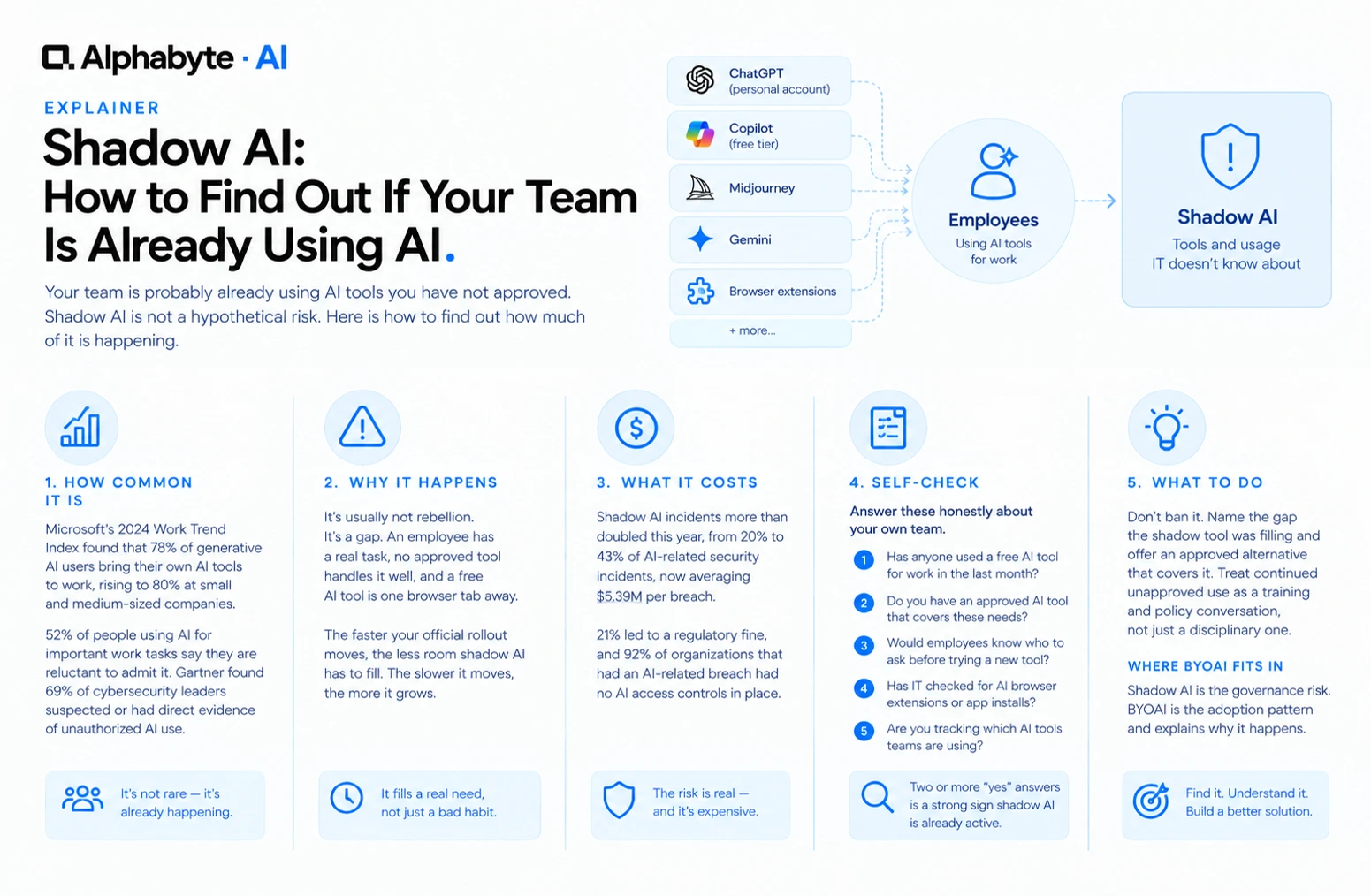
Shadow AI: How to Find Out If Your Team Is Already Using AI
Your team is probably already using AI tools you have not approved. Shadow AI is not a hypothetical risk. Here is how to find out how much of it is happening.
Read more →
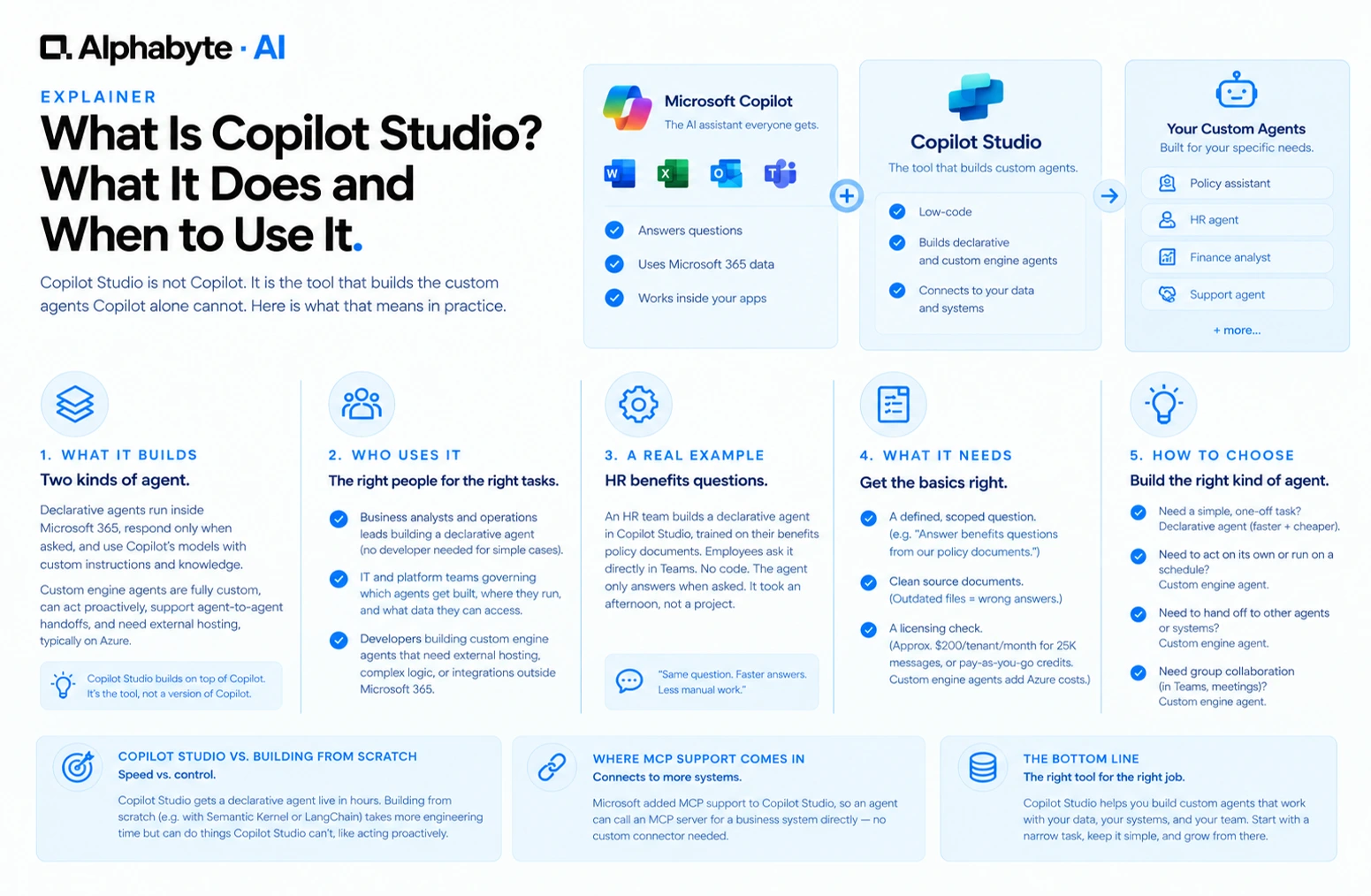
What Is Copilot Studio? What It Does and When to Use It
Copilot Studio is not Copilot. It is the tool that builds the custom agents Copilot alone cannot. Here is what that means in practice.
Read more →
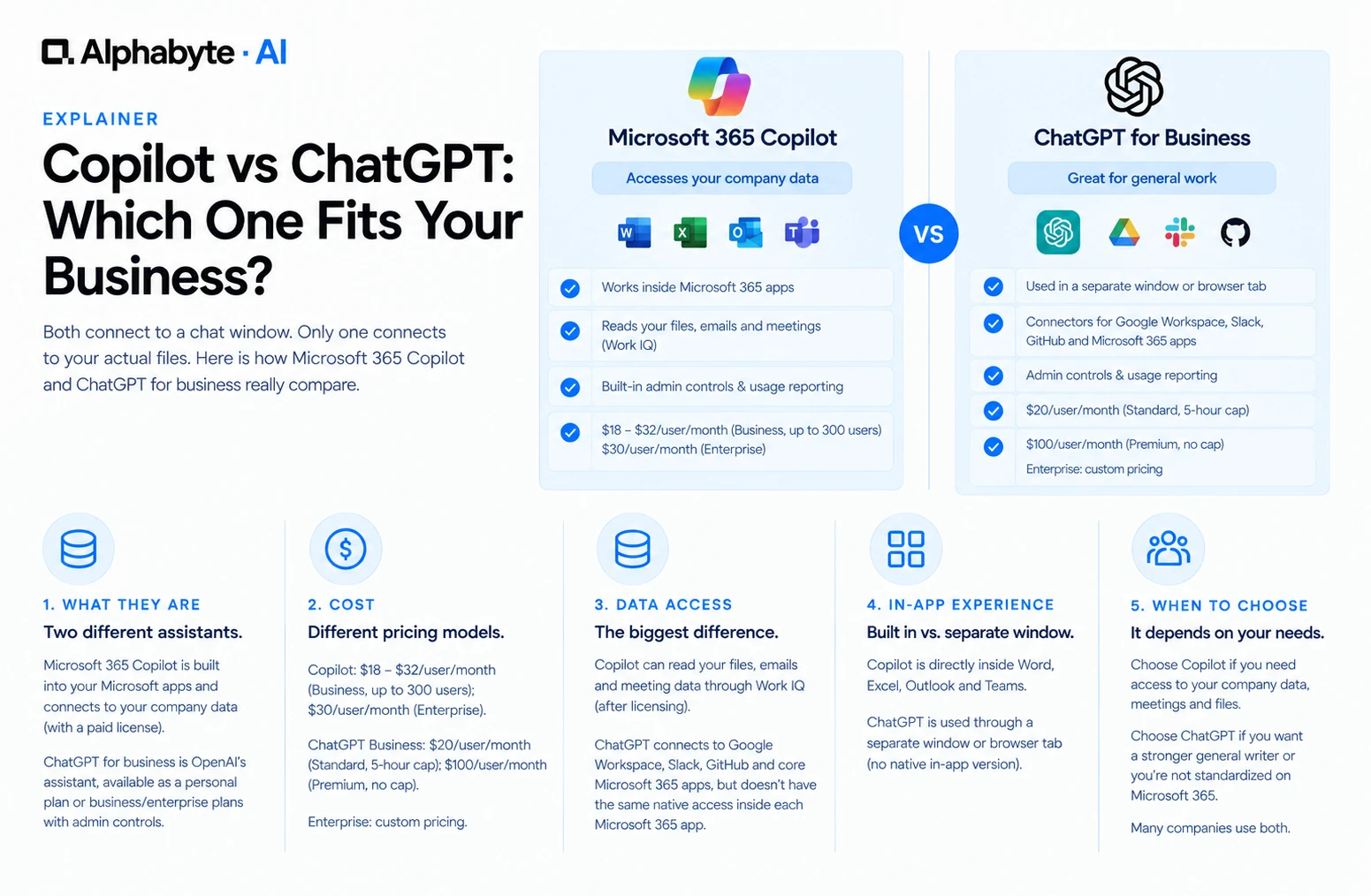
Copilot vs ChatGPT: Which Fits Your Business?
Both connect to a chat window. Only one connects to your actual files. Here is how Microsoft 365 Copilot and ChatGPT for business really compare.
Read more →