
Claude for Finance Teams: Eight Practical Workflows
Eight Claude workflows for FP&A, accounting, and controllers that replace hours of manual reporting each month. Built by the people who do the work.

Kevin Seto
April 21, 2026 · Updated May 6, 2026 · 9 min read
Finance teams spend days each month on reporting work that follows the same rules against different numbers. That pattern-based, rules-driven work is exactly where Claude delivers the clearest results.
Claude for finance is the deployment we recommend most often as a starting point. Finance has the highest concentration of automatable work, the most rigorous people to validate AI output, and the most measurable ROI. When variance commentary that took four hours now takes 20 minutes, and when the monthly close moves from day eight to day five, the CFO notices.
That proof point opens the door for every other department. We wrote about starting with the people who already know the work, and finance teams are the proof.
Why now
Finance departments face a specific pressure in 2026. McKinsey's 2024 "The state of AI" survey found that finance functions lag behind marketing and operations in AI adoption, despite having work that is arguably more suited to automation. The gap is not about capability. It is about governance concerns and the perception that AI cannot be trusted with financial data.
That perception is outdated. Anthropic's enterprise documentation details the data retention, audit logging, and access controls that make governed AI deployment practical for finance. The tools exist. The governance frameworks exist.
The question is whether your organisation deploys them formally or watches finance teams build ungoverned workflows on personal accounts. In our experience, the finance teams that are most cautious about AI governance are often the ones already using consumer AI tools informally, precisely because no governed alternative was offered.
Finance teams are the best starting point for AI deployment
Three characteristics make finance the right first department for AI deployment.
The work is pattern-based. Every month, the same reports get built from the same data sources. The structure does not change; the numbers do. This is exactly where Claude excels.
It follows a defined process, applies it to new data, and produces consistent output. Monthly closes, variance reports, budget consolidations, and vendor reconciliations all follow this pattern.
The people are rigorous. Accountants and FP&A analysts do not accept "close enough." They check the numbers. They reconcile. They spot when something is off by $12.
This rigour means they catch AI errors quickly, and they trust the output once they have verified it enough times to know it works. That verification instinct is exactly what makes AI deployment safe in finance: the same people who would never sign off on an unaudited report will not sign off on unverified AI output either. Deloitte's "State of AI in the Enterprise" survey identifies this kind of domain expertise as the strongest predictor of successful AI adoption.
The ROI is measurable. When a variance commentary that took four hours now takes 20 minutes, you can put a number on it. Finance gives you the clearest evidence that AI deployment is worth expanding to other departments.
That measurable proof is what moves AI from pilot to programme. We have written about why AI pilots stall and how measurable wins in a single department break the pattern.
Eight workflows your finance team can build this month
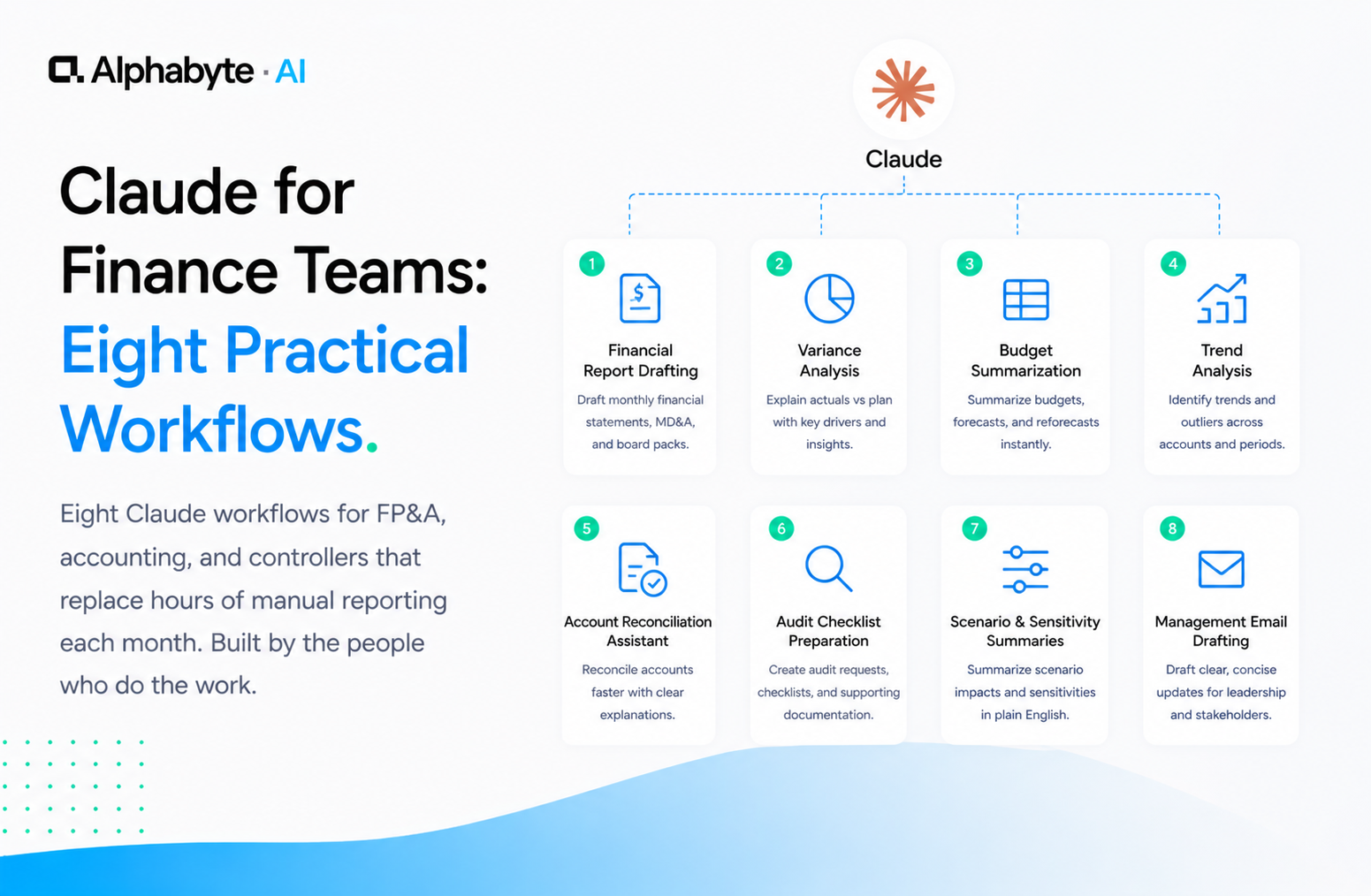
These are not aspirational. Each workflow connects to your existing financial systems via MCP and runs inside a governed environment deployed through our Citizen Development service.
-
Variance analysis commentary. Claude reads the monthly P&L, compares actual to budget, and drafts narrative explanations for material variances. Your team reviews and edits. What took three to four hours of writing now takes 30 minutes of review.
-
Budget vs actual consolidation across departments. Pull budget and actual data from multiple cost centres, consolidate into a single view, and flag departments that are off-plan. The consolidation is the tedious part. Claude handles it.
-
Vendor invoice matching and exception flagging. Match incoming invoices against POs and receiving documents. Flag discrepancies by amount, vendor, or line item. Your AP team focuses on exceptions instead of checking every invoice manually.
-
Cash flow forecasting from historical patterns. Claude analyses 12 to 24 months of cash flow data, identifies seasonal patterns and trends, and produces a rolling forecast. Not a replacement for your treasury function, but a starting point that improves as your team refines it.
-
Board deck financial summary generation. Take the monthly financial package and produce the two-page executive summary your board actually reads. Key metrics highlighted. Trends called out. Your CFO still reviews every word, but the first draft is done in minutes.
-
Intercompany reconciliation. For organisations with multiple entities, intercompany balances are a recurring headache. Claude matches transactions across entities, identifies mismatches, and produces the reconciliation workpaper.
-
Expense report audit and policy compliance. Review submitted expense reports against your company's expense policy. Flag violations: meals over the per diem, missing receipts, personal charges. Your team reviews the flags instead of reading every line.
-
Contract renewal tracking and obligation extraction. Claude reads vendor contracts, extracts key dates (renewal, termination, notice period), and maintains a tracking schedule. No more surprises when a contract auto-renews because nobody was watching the calendar.
The citizen developer pattern works especially well in finance
Here is how this plays out in practice. The controller builds the first workflow. She is tired of spending four hours every month writing variance commentary that says roughly the same things in roughly the same format. She connects Claude to the GL via MCP, builds a variance commentary tool, and runs it for the first close.
It works. She edits the output, corrects two numbers, adjusts the narrative tone. The second month, she edits less. By the third month, the commentary draft needs only minor adjustments, and the process that used to consume most of a Tuesday afternoon now takes 25 minutes.
She shares the pattern with the FP&A analyst. The FP&A analyst adapts the same approach for forecasting: same MCP connection to the GL, different prompt, different output. But the pattern (connect to data, apply rules, produce output, review) is identical.
This is the citizen developer playbook for finance. One person builds. The team learns from watching. The pattern spreads.
We have documented the full progression in our citizen developer enablement playbook.
In our engagements, we have seen this pattern replicate reliably. The executive productivity suite we built for a major supplier followed this exact citizen developer progression: one person with domain expertise built the first workflow, and the approach spread to the wider team. Purpose-built agents now deliver automated briefs and reports across the entire organisation.
Financial data governance is non-negotiable
No financial data should ever go into consumer AI tools. Not free ChatGPT, not a personal Claude account, not any tool without enterprise data controls. Under PIPEDA and the proposed Bill C-27, organisations have specific obligations around how personal and financial information is processed.
The governed environment for finance requires four components. Enterprise Claude with data retention policies, so your organisation controls how long conversation data is retained. Audit logging for every query, so your compliance team can review who asked what and when.
Access controls tied to your identity provider, so the AP clerk sees AP data and the controller sees the full GL. And MCP servers on your infrastructure, so the connections between Claude and your financial systems run on infrastructure you control.
This is not overhead. It is the foundation that makes everything else possible. Without governance, your CFO will not approve the deployment, and rightly so. Financial data carries regulatory obligations that consumer AI tools are not designed to meet.
With proper governance in place, finance becomes the model for every other department. The audit trail that satisfies your external auditors also gives leadership confidence to expand AI into operations, sales, and HR. Our AI governance framework covers the full governance model, and our post on private LLM vs Claude Enterprise compares deployment options for organisations with strict data residency requirements.
Pick the workflow that takes the most hours per month. For most teams, that is variance commentary or budget consolidation. Build it first. Prove it works. Measure the time saved.
That measurable result is your proof point for expanding to the next workflow and the next department. The finance team that starts with one working workflow in month one has eight by month six. If you are ready to start, book a Discovery call and we will map your finance workflows in the first session.
Frequently Asked Questions
What finance workflows can Claude automate?
Claude can handle variance analysis commentary, budget consolidation across departments, vendor invoice matching, cash flow forecasting, board deck summaries, intercompany reconciliation, expense report auditing, and contract renewal tracking. Each workflow connects to your existing financial systems via MCP and runs inside a governed environment.
Is it safe to use Claude with financial data?
Only with proper governance. Financial data should never go into consumer AI tools. Enterprise Claude with SSO, data retention policies, audit logging, and MCP servers on your own infrastructure keeps data in your environment while maintaining a full audit trail for compliance.
How long does it take to deploy the first finance workflow?
Most teams deploy their first workflow (typically variance commentary or budget consolidation) within two to three weeks. The governed environment is configured in the first sprint, and the first working tool follows shortly after. By month six, teams typically have multiple workflows running.
Do finance teams need technical skills to build Claude workflows?
No. The citizen developer model means finance professionals describe their work in plain English. Claude builds the tool. The governed environment with an SDLC plugin handles versioning and review. The people who know the work build the tools, and they do not need to write code.
How does Claude connect to our GL or ERP system?
Through MCP (Model Context Protocol) servers configured on your infrastructure. MCP provides a standard way to connect Claude to your CRM, ERP, GL, and document stores. Your existing permissions model stays intact, and data does not leave your environment.
Kevin Seto
Director, Analytics and Project Delivery. Kevin leads analytics and project delivery at Alphabyte Solutions, helping businesses harness the power of data to identify opportunities for improvement and drive strategic decisions. He develops comprehensive BI roadmaps and data-driven strategies that enhance operations, boost revenue, and reduce costs.
View full profile →More from the blog
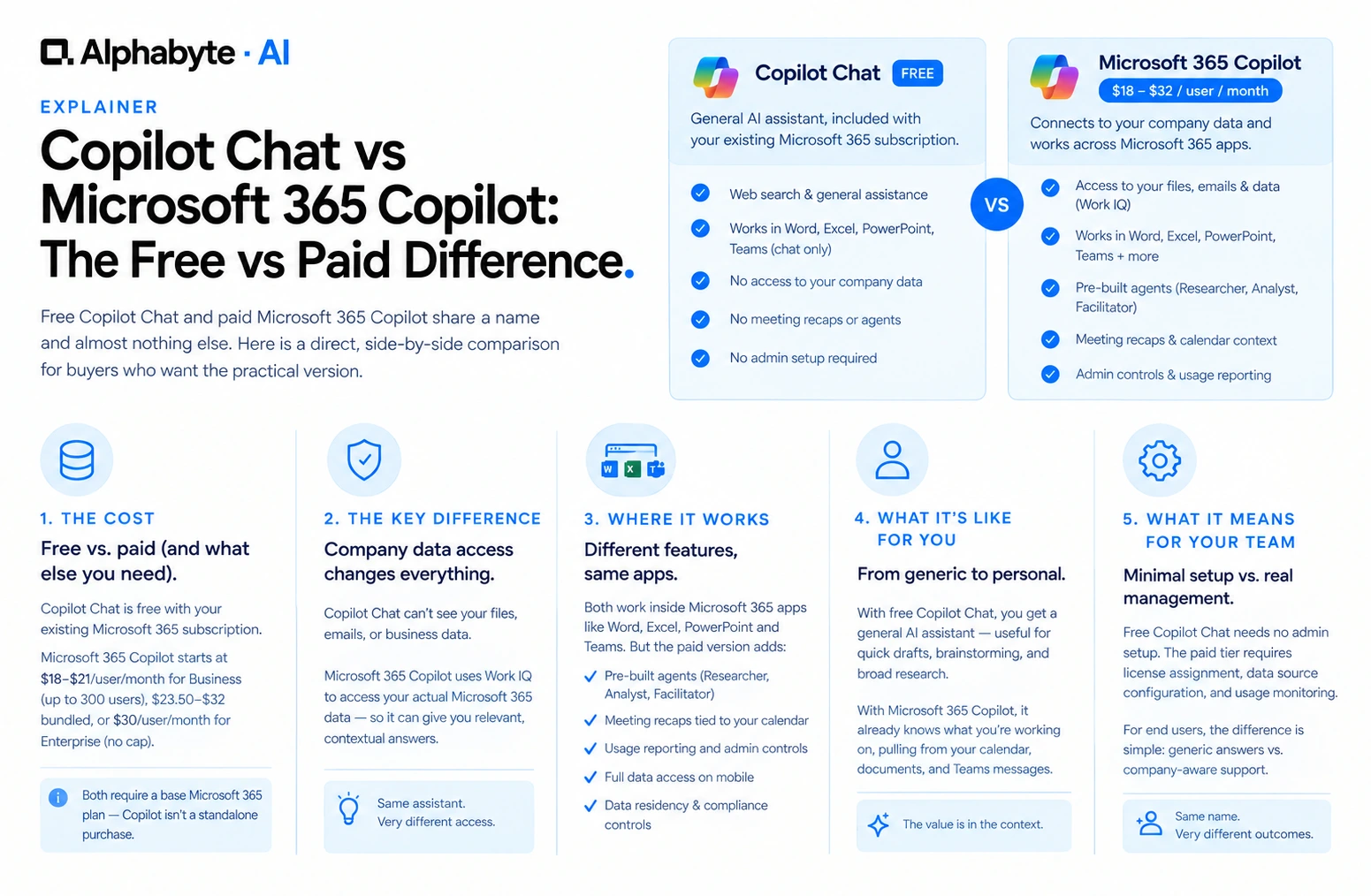
Copilot Chat vs Microsoft 365 Copilot: The Free vs Paid Difference
Free Copilot Chat and paid Microsoft 365 Copilot share a name and almost nothing else. Here is a direct, side-by-side comparison for buyers who want the practical version.
Read more →
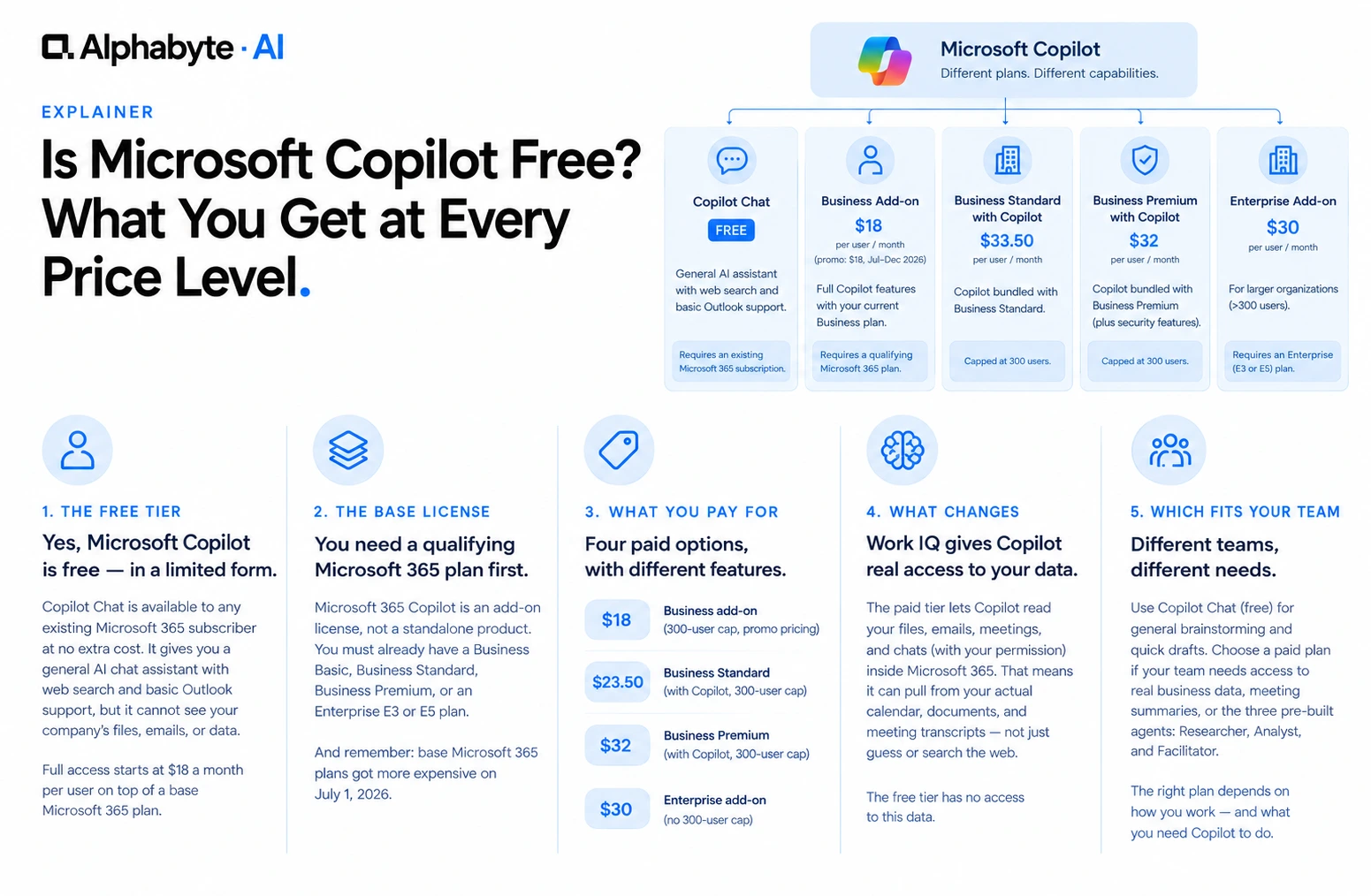
Is Microsoft Copilot Free? What You Get at Every Price Level
Microsoft Copilot has a free tier, but it is missing the one feature most businesses actually want. Here is what each price level actually includes, and what it requires underneath.
Read more →
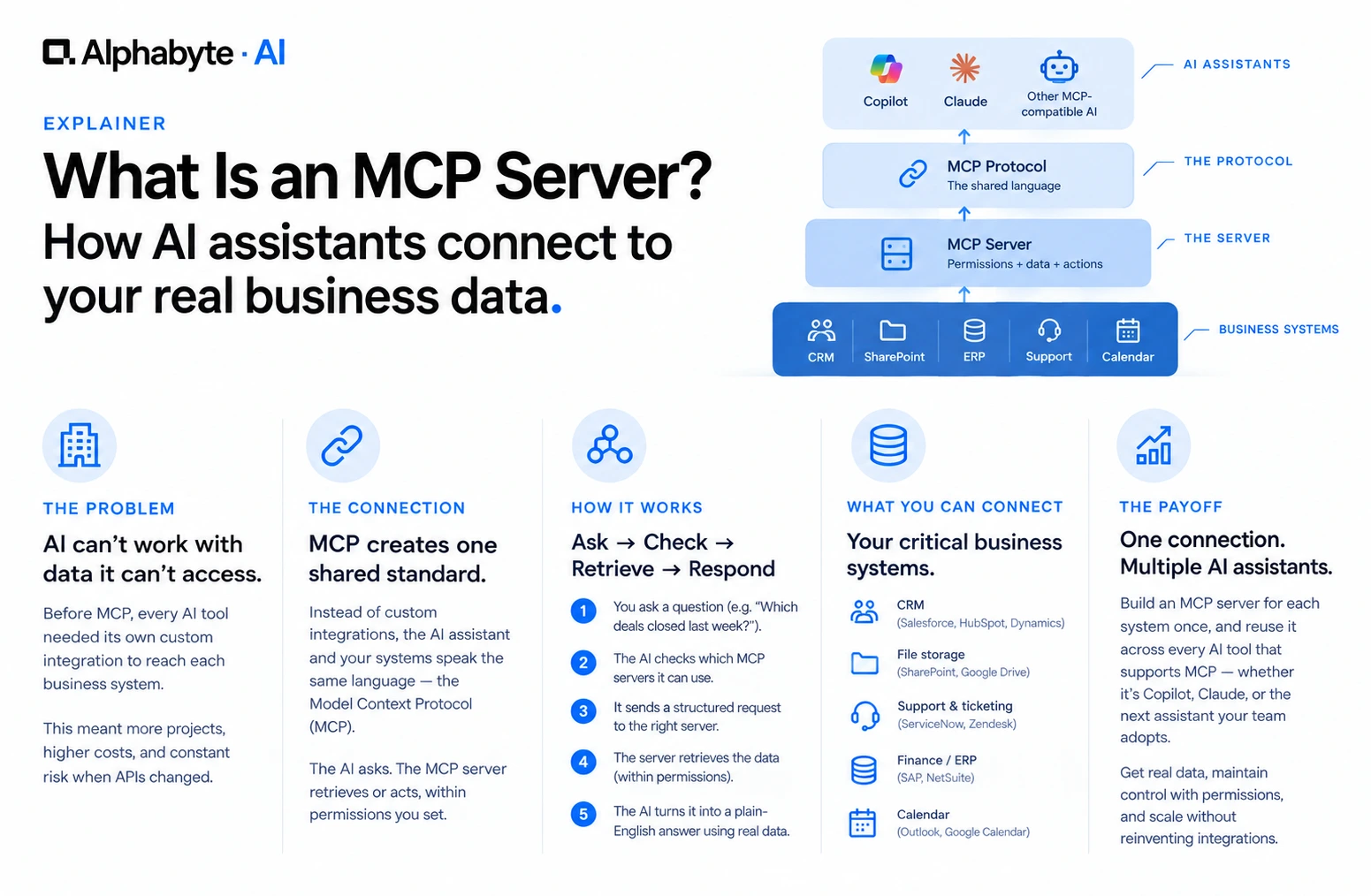
What Is an MCP Server? A Plain-English Guide for Business Teams
MCP servers let AI tools like Copilot and Claude read your company's real data instead of guessing. Here is what that means, without the engineering jargon.
Read more →