Why Most Mid-Market AI Pilots Stall Before They Ship
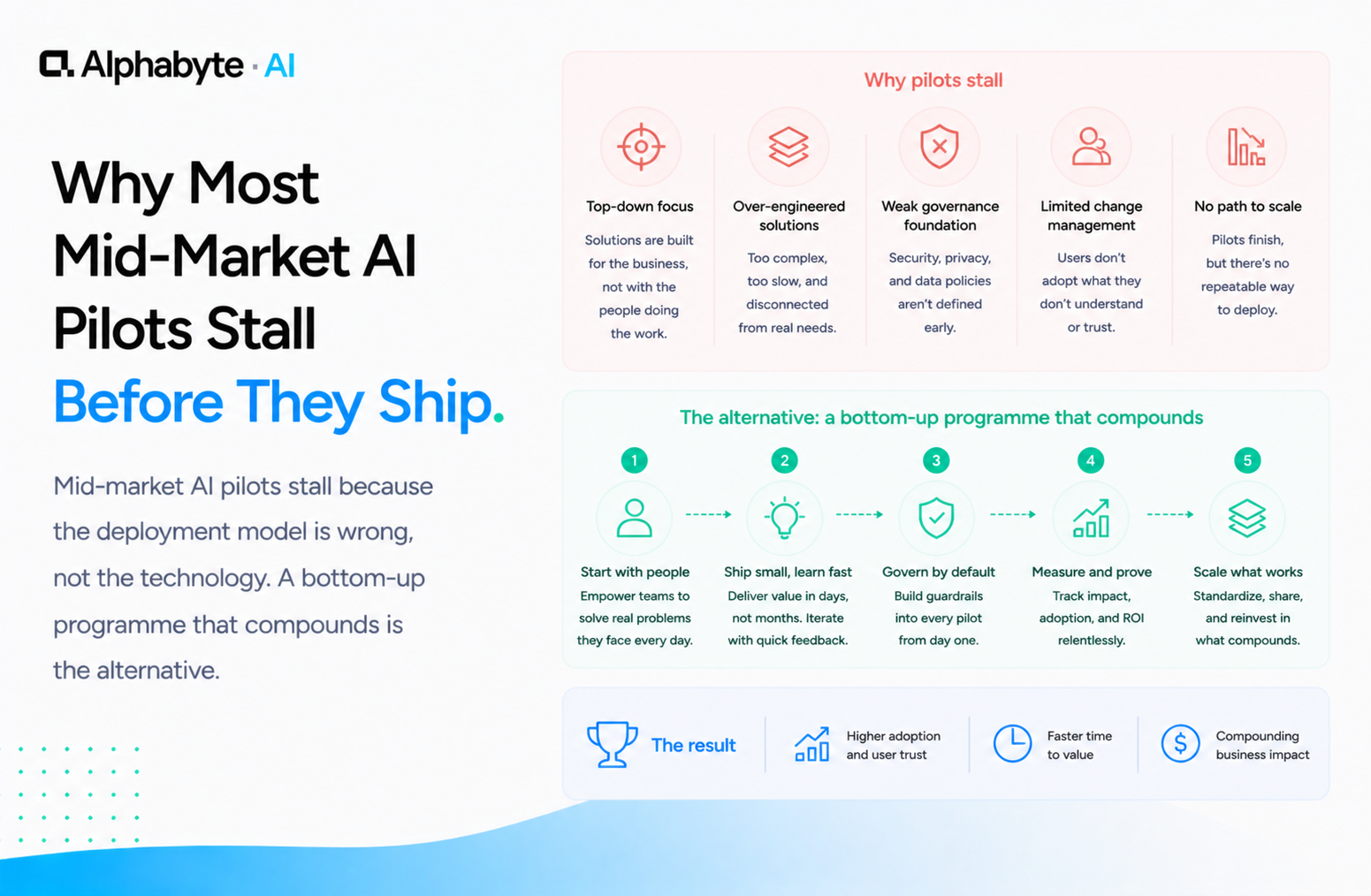
Mid-market AI pilots stall because the deployment model is wrong, not the technology. A bottom-up programme that compounds is the alternative.

Adam Nameh
May 6, 2026 · 8 min read
A vendor approaches with a compelling AI pilot. The demo runs on clean data. The results look impressive. Six months later, the pilot is "on hold" and the budget is spent. Why do AI pilots fail so consistently at mid-market companies?
The technology is not the problem. The deployment model is. Top-down pilots fail because they optimise for the demo rather than for daily operations.
A bottom-up programme, where the people who do the work build the workflows they need against real data, produces something a pilot never does: a pattern that compounds. Each new workflow is cheaper and faster than the last because the infrastructure, the governance, and the institutional knowledge already exist.
Why this matters now
McKinsey's 2024 "The state of AI" survey found that organisations reporting meaningful AI ROI were those that had moved beyond isolated pilots into broader operational adoption. The gap between organisations that deployed AI into production and those still running pilots widened significantly year over year.
For mid-market companies, the cost of a stalled pilot is not just the budget spent. It is the months of lost compounding while competitors who adopted the right model pull further ahead.
What Does a Stalled AI Pilot Look Like?
The pattern is consistent across industries. A use case is selected, usually something that sounds impressive: document processing, customer service automation, predictive analytics. The vendor runs the demo against curated sample data.
Leadership signs off and budget is allocated.
Then reality arrives. The production data has inconsistencies the demo data did not. The integration with the ERP takes three months, not the two weeks quoted. The use case that looked perfect in the demo does not map to how your team actually works, because nobody asked your team before choosing it.
Six months later, the pilot is in purgatory: a successful proof of concept that never becomes a production system. The vendor points to the demo as proof the technology works. And it did work, in conditions that do not exist inside your business.
In our engagements, we have seen this exact pattern at organisations across manufacturing, professional services, and financial services. A housing services organisation we worked with had run two separate pilots with two different vendors before engaging us for an AI enablement roadmap. Both pilots had produced successful demos. Neither had produced a single workflow anyone used daily.
The gap between demo and daily use is where most mid-market AI investments go to fail. The vendor is not lying when they say the technology works. It does work, in conditions that bear no resemblance to your Tuesday morning. Understanding why requires examining the deployment model, not the technology.
Three Deployment Failures That Kill Pilots Before Production
The failure modes are predictable. We see the same three on nearly every stalled engagement.
The use case was chosen top-down. Leadership picked the most impressive-sounding application, the one that would look best in a board presentation, instead of the one that maps to an actual workflow someone does every day. The best AI use cases are not glamorous. They are the tedious, repetitive tasks that consume four hours of someone's Tuesday.
But nobody asks the person with the tedious Tuesday. Our executive enablement programme addresses this directly by connecting leadership to the operational workflows that matter.
The pilot ran on clean data. Every demo uses curated data. Production data is never curated. It has missing fields, inconsistent formatting, legacy encoding, and edge cases that represent 30 percent of actual volume. Nobody budgeted for data readiness because the demo did not require it.
In our experience, data cleanup is the single most underestimated line item in AI pilot budgets. Teams allocate weeks for model configuration and days for data preparation, when the ratio should be reversed. When the team tries to move from pilot to production, the data work alone takes longer than the entire original timeline.
Nobody owned the production path. The pilot had a champion, usually someone in IT or innovation. But that person's job was to run the pilot, not to move it into daily operations. There was no integration plan, no training plan, no support model.
The pilot existed in a vacuum, and when the champion moved on to the next initiative, the pilot stopped moving entirely. We have seen this pattern repeatedly: the person who ran the demo is not the person who would use the tool daily, and nobody bridged that gap.
These are not technology failures. They are deployment failures. Deloitte's "State of AI in the Enterprise" survey consistently identifies the gap between pilot and production as the primary barrier to AI ROI. Our AI governance framework covers how to build the operational structure that prevents these failures.
The Bottom-Up Programme Is the Alternative
The alternative to a top-down pilot is a bottom-up programme. Instead of picking one big use case and building toward a demo, you start with the people already doing the work.
Give three people governed access to Claude. Connect it to one real system: your CRM, your ERP, your document repository. Let them build what they actually need. Not what would look impressive in a presentation. What would save them two hours on Thursday.
The first workflow is small. Maybe it is a report that used to take 45 minutes and now takes five. The second workflow borrows the data connection pattern from the first. The third one is built by someone who saw the first person's output and asked, "Can it do this for my process too?"
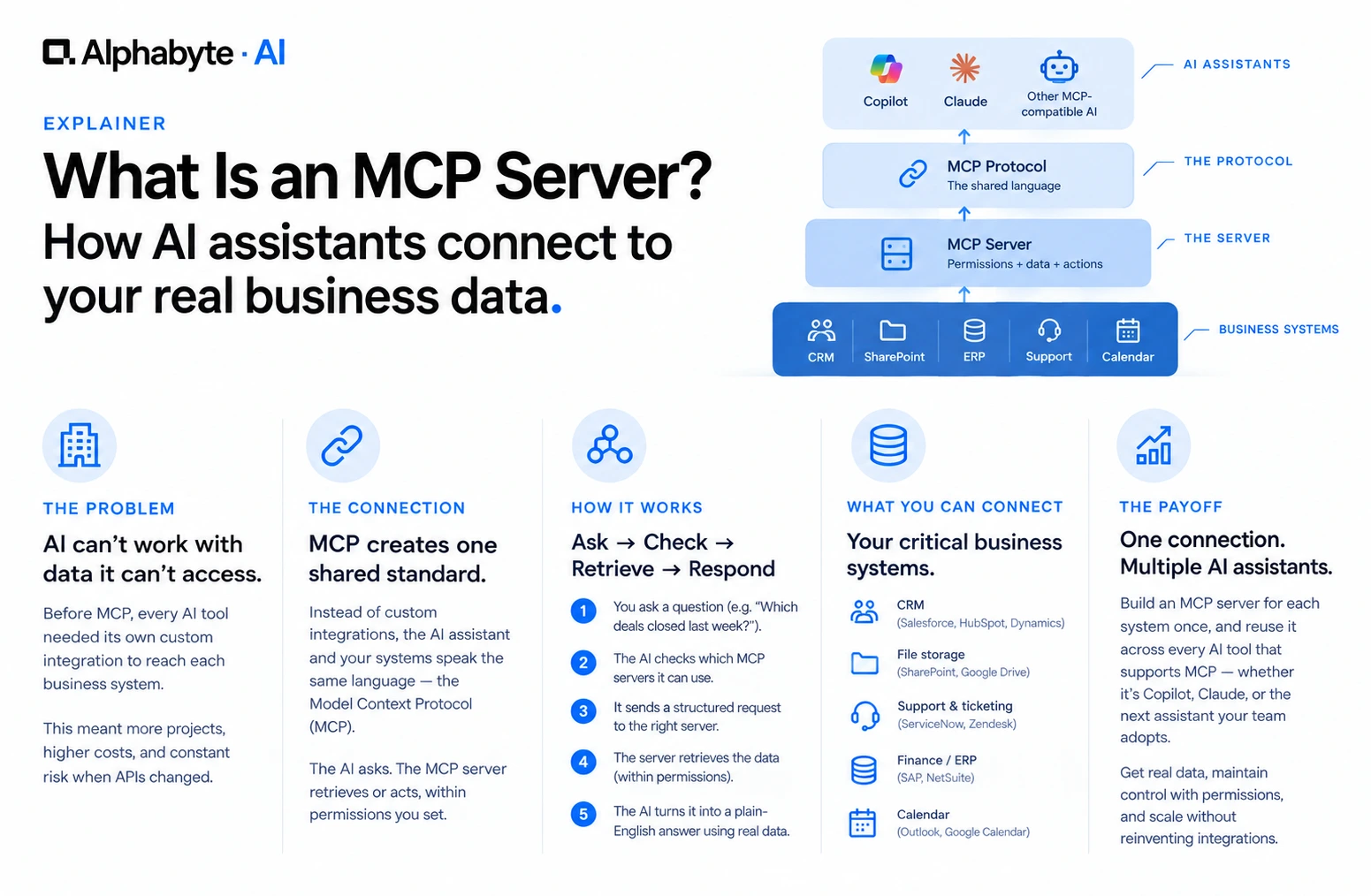
By the tenth workflow, you have something a pilot never produces: a pattern that compounds. Each new workflow is cheaper and faster than the last because the infrastructure, the governance, and the institutional knowledge already exist. The MCP connections are already configured. The permission model is already in place.
The team already knows how to describe their work to Claude and review the output. This is the model we describe in our citizen developer enablement playbook. The key difference from the top-down approach: nobody waits for a perfect use case. You start with a good-enough workflow, prove it against real data, and build from there.
Anthropic's documentation on Claude for enterprise outlines the usage patterns that support this model: team-level access controls, audit logging, and API integration that lets you connect Claude to internal systems through the same governed infrastructure your team already operates under. The governance is not a separate project. It is part of the first deployment, and every subsequent workflow inherits it automatically.
What Compounding Looks Like Over Twelve Months
Here is the timeline we see when organisations adopt the bottom-up model.
Month one. Three people are automating their own workflows. The outputs are small: a reporting shortcut, an automated data pull, a document drafting tool. Each one saves a few hours per week. Individually, none of them would justify a board presentation.
Month three. Twelve workflows are running against real production data. The original three builders are helping colleagues adapt patterns for adjacent use cases. The governance framework that was built in week two is handling the volume without issues. Total time saved across the organisation: measurable and growing.
Month six. The team that started first is training the next team. The pattern library has enough proven templates that new workflows take days, not weeks. Someone in finance built a forecasting tool by adapting what someone in operations built for scheduling. We deployed a similar compounding pattern for a construction firm: the compliance intelligence agent started as a single lookup tool and grew into a system that the entire team relied on for daily regulatory checks.
Month twelve. You do not have one AI application. You have 40 or 50, built by the people who understand the work, running against the systems that matter, governed by a framework that was battle-tested from month one. The total time saved across the organisation is measurable in full-time equivalents, and the cost per workflow has dropped to a fraction of what the original pilot budget allocated for a single use case.
Most organisations that ask us about AI strategy are recovering from a stalled pilot. The conversation is always the same: the technology worked, the deployment did not. The fix is not a better pilot. It is a different model entirely. If that describes your situation, Discovery is where we would start.
Frequently Asked Questions
Why do most AI pilots fail to reach production?
Most AI pilots stall because of deployment failures, not technology failures. The three most common causes are choosing use cases top-down without consulting the people who do the work, running pilots on clean demo data that does not reflect production conditions, and having no owner for the path from pilot to daily operations.
What is a bottom-up AI deployment model?
A bottom-up AI deployment gives a small group of employees governed access to AI tools connected to one real system. They build workflows that solve their own problems. Each new workflow reuses infrastructure and governance from previous ones, creating a compounding pattern that a top-down pilot never produces.
How long does it take to see ROI from a bottom-up AI programme?
In the bottom-up model, measurable time savings appear within the first month as initial users automate their own workflows. By month three, twelve or more workflows are typically running against production data. By month six, the compounding effect means new workflows take days rather than weeks to deploy.
What is AI pilot purgatory?
AI pilot purgatory describes the state where a proof of concept has demonstrated that the technology works, but the project never ships to production. The demo succeeded, the budget was spent, but no one uses the system in daily operations. This is the most common outcome for top-down mid-market AI pilots.
How do I prevent my AI pilot from stalling?
Start with a workflow someone does every day, not the most impressive use case for a board presentation. Use real production data from day one. Assign an owner for the production path, not just the pilot phase. Better yet, adopt a bottom-up model where the people who do the work build the workflows they need.
Adam Nameh
Co-Founder, AI Practice. Adam Nameh is the Co-Founder of Alphabyte Solutions Inc., a Toronto-based data and AI consulting firm that has helped over 100 clients across North America turn complex data environments into actionable business intelligence. With a decade of hands-on experience in data architecture and platform design, Adam works directly with leadership teams to deliver practical AI and data solutions that drive real business outcomes.
View full profile →More from the blog
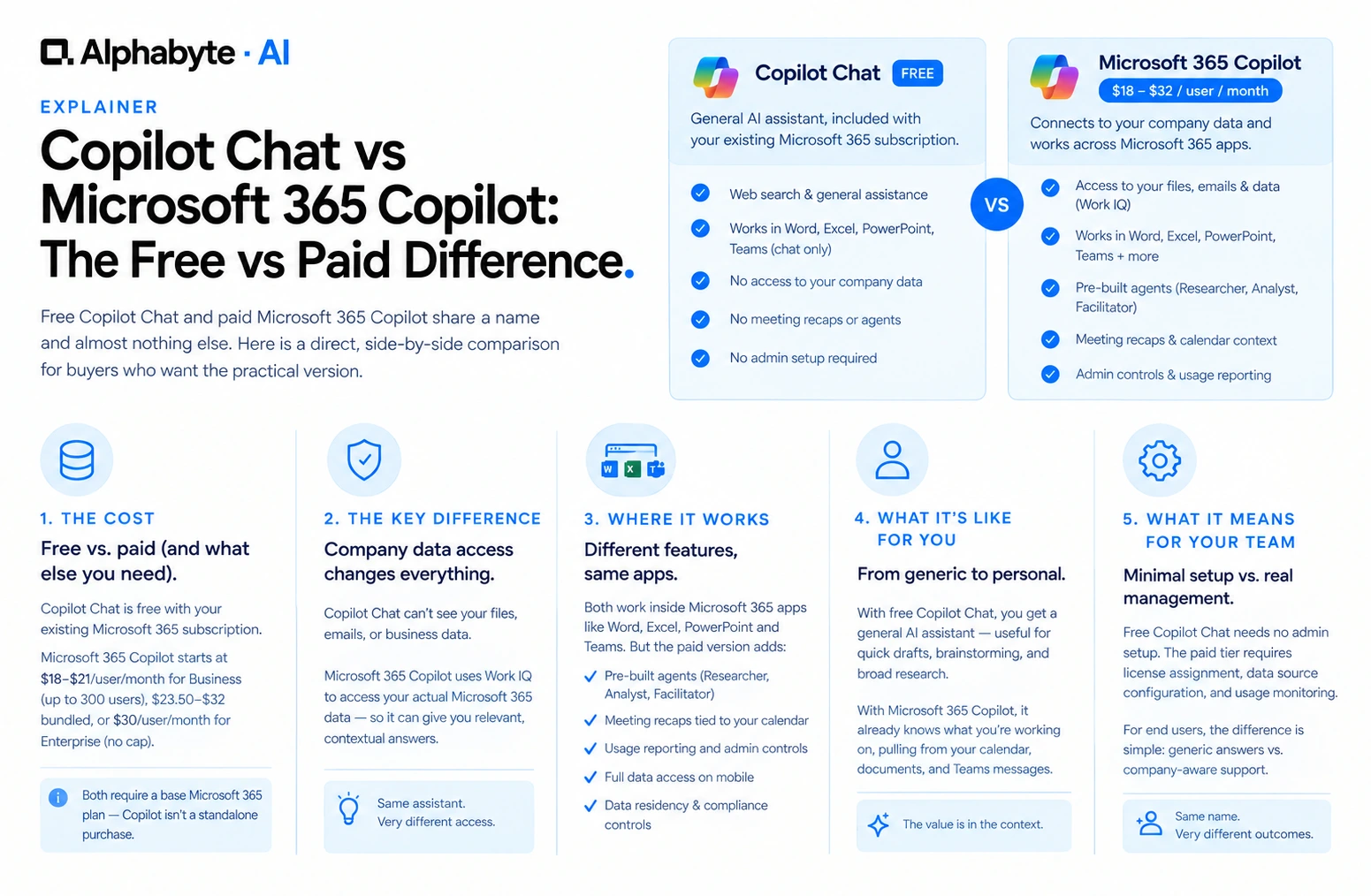
Copilot Chat vs Microsoft 365 Copilot: The Free vs Paid Difference
Free Copilot Chat and paid Microsoft 365 Copilot share a name and almost nothing else. Here is a direct, side-by-side comparison for buyers who want the practical version.
Read more →
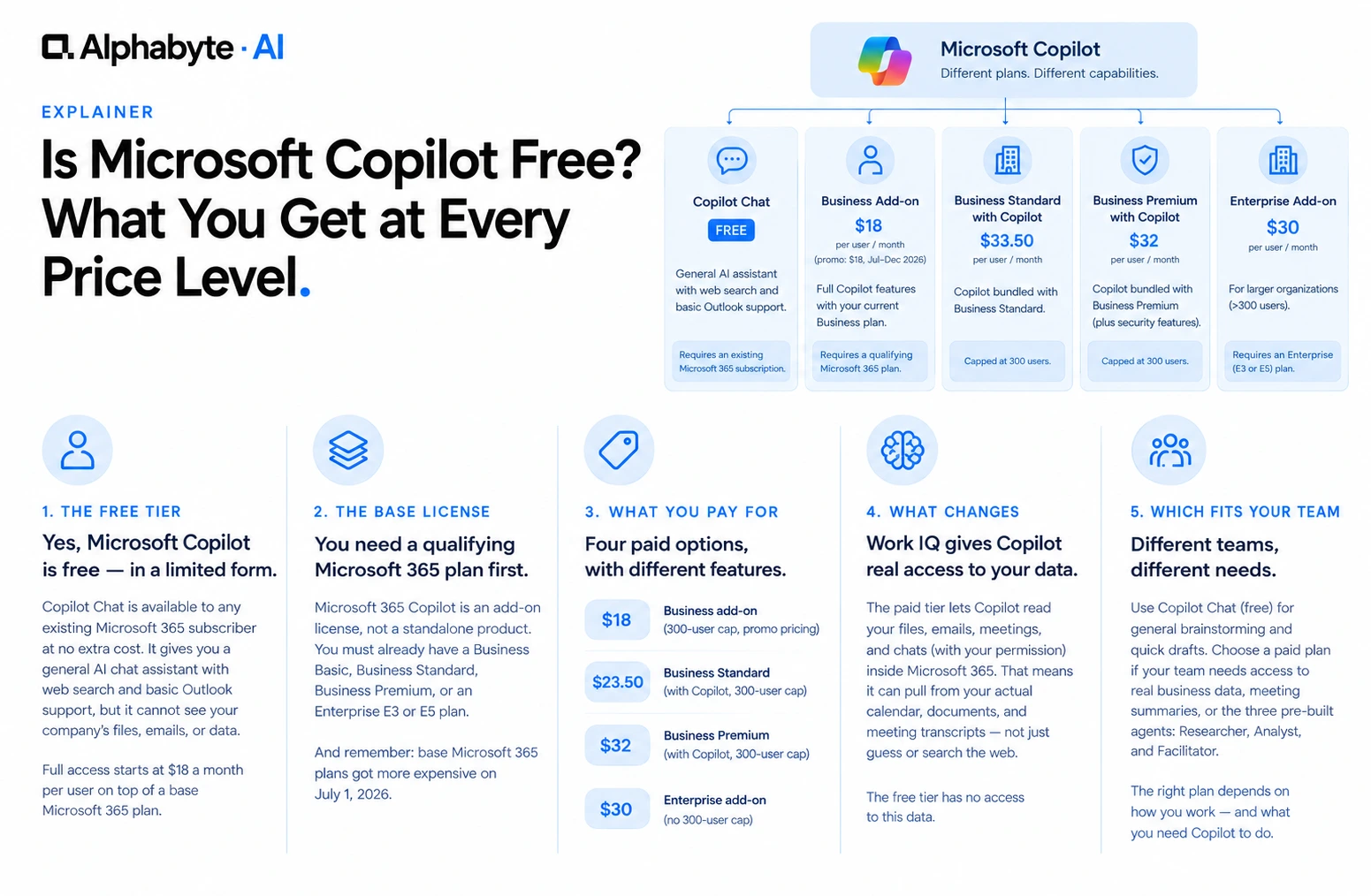
Is Microsoft Copilot Free? What You Get at Every Price Level
Microsoft Copilot has a free tier, but it is missing the one feature most businesses actually want. Here is what each price level actually includes, and what it requires underneath.
Read more →
What Is an MCP Server? A Plain-English Guide for Business Teams
MCP servers let AI tools like Copilot and Claude read your company's real data instead of guessing. Here is what that means, without the engineering jargon.
Read more →