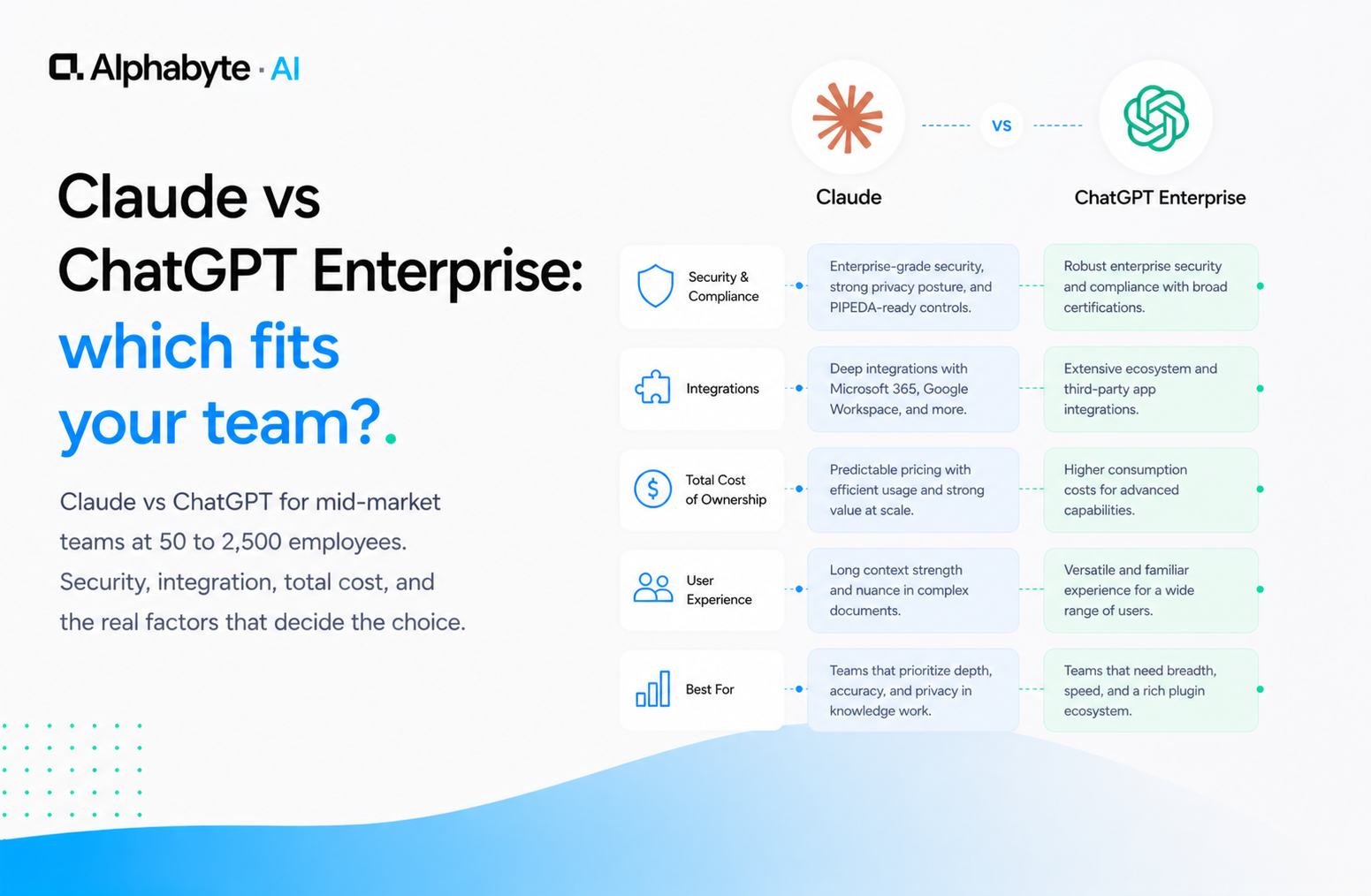
Claude vs ChatGPT Enterprise: which fits your team?
Claude vs ChatGPT for mid-market teams at 50 to 2,500 employees. Security, integration, total cost, and the real factors that decide the choice.

Rugved Ambekar
April 24, 2026 · Updated May 6, 2026 · 8 min read
Mid-market leaders keep asking the same question: Claude or ChatGPT? The online comparisons focus on benchmarks and model size, but neither metric tells you which platform will actually work when you need 200 people productive in six weeks.
The short answer is that Claude and ChatGPT serve different needs, and the right choice depends on what kind of work you are trying to do with AI. Claude is the stronger platform when your priority is connecting AI to operational systems, reasoning through complex documents, and building governed workflows against real business data. ChatGPT is the stronger platform when your priority is broad adoption with minimal friction and access to a wide plugin ecosystem.
Many mid-market organisations end up using both. That is not a hedge. It is a recognition that different problems call for different tools.
Why this comparison matters now
The mid-market AI landscape shifted significantly in 2025 and into 2026. According to McKinsey's 2024 "The state of AI" survey, 72 percent of organisations now report adopting AI in at least one business function, up from 55 percent the year prior. For mid-market companies, this means the question is no longer whether to adopt AI. It is which platform to standardise on first.
At the same time, Anthropic has expanded Claude's enterprise capabilities with Model Context Protocol (MCP), which changes the integration picture entirely. The gap between "chatbot you talk to" and "agent that acts on your systems" has narrowed. That gap is where the Claude vs ChatGPT decision actually lives for mid-market teams.
What do mid-market buyers actually need from AI?
Enterprise buyers and mid-market buyers optimise for different things. At 10,000 employees, the priorities are global compliance frameworks, custom model fine-tuning, and multi-year licensing. At 50 to 2,500 employees, the priorities look different.
Speed to first deployment matters most. Can your team be using this in weeks, not quarters? Mid-market teams rarely have the runway for a six-month rollout, so the platform that delivers a working use case fastest has a structural advantage.
Total cost at actual scale matters too. Not the per-seat price on the website, but the real cost when 200 people are active users with varying usage patterns. API overages, premium feature add-ons, and the internal hours spent on administration all factor in.
Integration with existing systems is the third priority. You are not building from scratch. You have a CRM, shared drives, and a dozen SaaS tools that AI needs to connect to.
Finally, you need governance without a dedicated team. You need audit logs, data controls, and access management, but you do not have a six-person compliance team to manage it. Both Claude and ChatGPT can serve mid-market organisations, but they approach these priorities from different directions.
Claude is stronger for operational depth
Claude's advantages show up most clearly in three areas that compound over time for mid-market deployments.
First, reasoning depth on complex tasks. When your team needs to analyse a 40-page contract, synthesise data from multiple sources, or work through a multi-step business problem, Claude consistently produces more thorough output. Anthropic's documentation on extended thinking describes how Claude can show its reasoning process, which matters when decisions need to be auditable.
This is not a subjective preference. It shows up in how the model handles ambiguity, qualifies its conclusions, and catches edge cases that simpler models miss.
Second, system integration via MCP. Model Context Protocol lets Claude connect directly to your business systems: your CRM, your databases, your file storage. In our engagements with mid-market teams, we have built custom MCP servers connecting Claude to Salesforce, BigQuery, and Google Drive.
The practical difference is that your team can ask Claude questions about real customer data and real financial numbers without copying data into prompts. MCP servers also respect your existing permissions model, so the sales team sees sales data and the finance team sees the general ledger.
Third, the citizen developer pathway. Claude Projects give teams a way to build shared knowledge bases. Claude Code gives technical users a direct path from idea to working application.
These are not features for power users only. They are the infrastructure that lets your operations, finance, and analytics teams build their own AI workflows. We cover Claude's full capability set on our Claude tools page.
ChatGPT is stronger for broad adoption
An honest comparison requires honesty about where ChatGPT has real advantages.
Brand recognition matters more than technologists want to admit. When you tell your CEO you are deploying ChatGPT, they nod. When you say Claude, you get questions. Internal buy-in is half the battle, and ChatGPT's name recognition reduces change management friction.
According to Deloitte's "State of AI in the Enterprise" survey, familiarity with the tool is one of the top three factors driving enterprise AI adoption decisions.
ChatGPT's plugin and GPT marketplace is larger. If your use case maps neatly to an existing plugin, you can be up and running with less custom work. GPT-4o also handles image, audio, and video inputs across a wider range of scenarios. If your workflows involve heavy visual content, ChatGPT's multimodal pipeline is more mature.
OpenAI has also been selling to enterprises longer. Their procurement process, security documentation, and enterprise support infrastructure reflect that experience. For organisations where the purchasing process itself is a constraint, this matters.
Security questionnaires are pre-filled, SOC 2 documentation is readily available, and the procurement team has likely already evaluated OpenAI's terms. That head start on the compliance paperwork is a real advantage when your timeline is tight.
Which platform integrates better with your systems?
This is where the real difference shows up for mid-market organisations.
ChatGPT's plugin model was designed for consumers. Browse the web, generate images, query a dataset. It works well for individual productivity. But connecting ChatGPT to your specific Salesforce instance, your internal databases, or your proprietary tools requires significant custom development.
In our experience, mid-market teams often underestimate that integration cost. The API work, the authentication layer, the error handling, and the ongoing maintenance add up quickly when you are connecting to three or four operational systems.
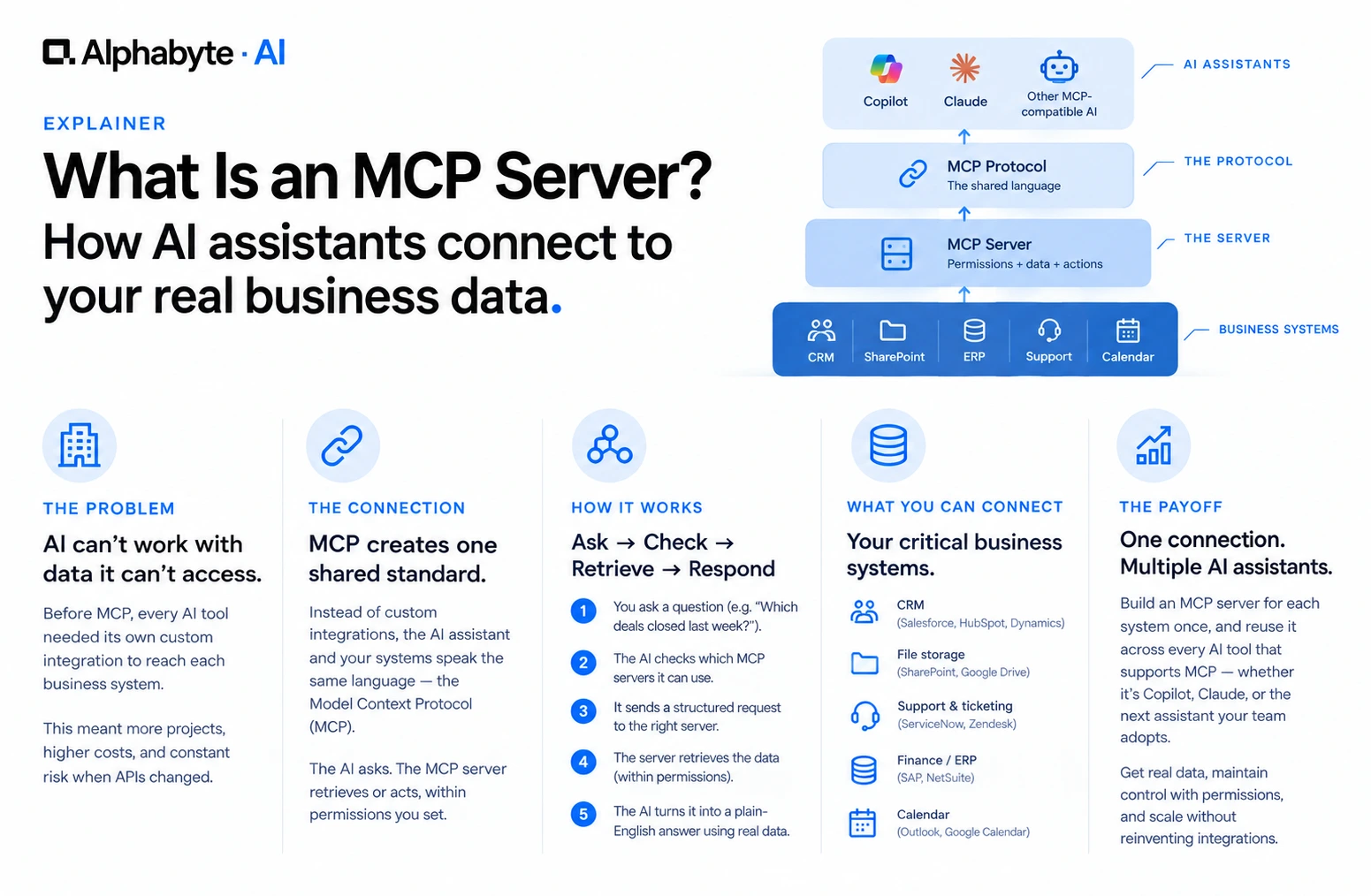
Claude's MCP architecture was designed for exactly this problem. An MCP server is a small, focused service that connects Claude to one of your systems. It respects your permissions, logs every interaction, and runs on your infrastructure.
We built an executive productivity suite for a major supplier that connects Claude to GSuite, Slack, Power BI, and Fireflies through purpose-built agents. The integration took weeks, not months, because MCP handled the connectivity layer.
For a mid-market organisation with limited engineering capacity, this is often the deciding factor. If you need AI connected to your operational data, the path with Claude is shorter. Our Discovery service identifies which integrations deliver the most value first. If your data is not yet organised for AI consumption, our Data Readiness engagement addresses that gap before deployment begins.
How should a mid-market team decide?
Choose Claude if your primary goal is connecting AI to your operational systems and building workflows that act on real business data. The MCP infrastructure, reasoning depth, and enterprise governance model make it the stronger platform for operational AI that reduces manual work and improves decision quality.
Choose ChatGPT if your primary goal is broad adoption with minimal change management. If you need 500 people using AI for general productivity (drafting emails, summarising documents, brainstorming) and you want the lowest friction path, ChatGPT's brand recognition and ecosystem breadth will get you there faster. The onboarding cost is lower, the training requirement is minimal, and your team is likely already familiar with the interface from personal use.
The honest answer for many mid-market organisations is both. ChatGPT for general productivity across the organisation. Claude for the operational workflows that connect to your systems and deliver measurable ROI.
The mistake we see most often is treating this as a permanent, exclusive decision. In our engagements, we have seen organisations start with Claude for one department's operational workflows and later add ChatGPT for broader productivity, or vice versa. The key is matching the platform to the problem, not committing to a single vendor before you understand your own use cases.
Start with the platform that matches your highest-priority use case and expand from there. If you are evaluating which path fits your organisation, our Discovery service is designed to answer that question in weeks, not months.
Frequently Asked Questions
Is Claude or ChatGPT better for mid-market companies?
It depends on the use case. Claude is stronger for deep reasoning, system integration via MCP, and governed workflows against operational data. ChatGPT has broader brand recognition, a larger plugin ecosystem, and more mature multimodal features. Many mid-market organisations use both.
Can Claude connect to my CRM and business systems?
Yes. Anthropic's Model Context Protocol (MCP) lets Claude connect directly to systems like Salesforce, BigQuery, Google Drive, and internal databases. MCP servers respect your existing permissions and log every interaction.
How much does Claude Enterprise cost compared to ChatGPT Enterprise?
Pricing varies by seat count and usage. Both platforms offer tiered enterprise plans. The real cost difference shows up in integration: Claude's MCP architecture often reduces the custom development needed to connect AI to your operational systems.
Do I need to choose one platform exclusively?
No. Many mid-market organisations deploy ChatGPT for broad productivity tasks and Claude for operational workflows that connect to business systems. Starting with the platform that matches your highest-priority use case is usually the best approach.
Rugved Ambekar
Head of AI Engineering. Rugved Ambekar is an AI applications engineer with 15+ years shipping software across mobile, full-stack, desktop, and AI. He has led three fractional CTO engagements, raised a $1.3M seed round, and solo-built entire SaaS platforms. At Alphabyte, Rugved builds AI agents, custom MCP servers, and governed environments for mid-market clients.
View full profile →More from the blog
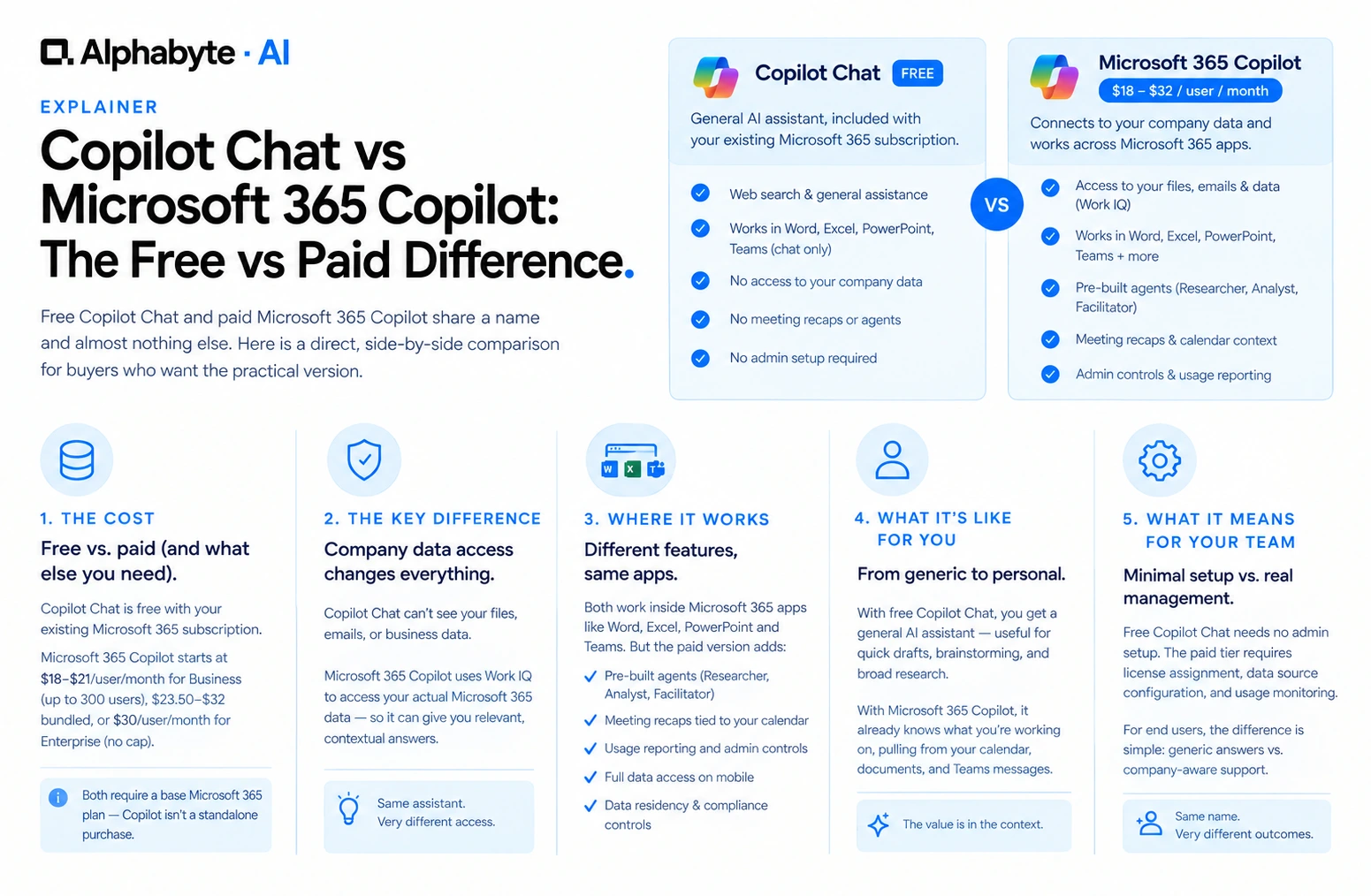
Copilot Chat vs Microsoft 365 Copilot: The Free vs Paid Difference
Free Copilot Chat and paid Microsoft 365 Copilot share a name and almost nothing else. Here is a direct, side-by-side comparison for buyers who want the practical version.
Read more →
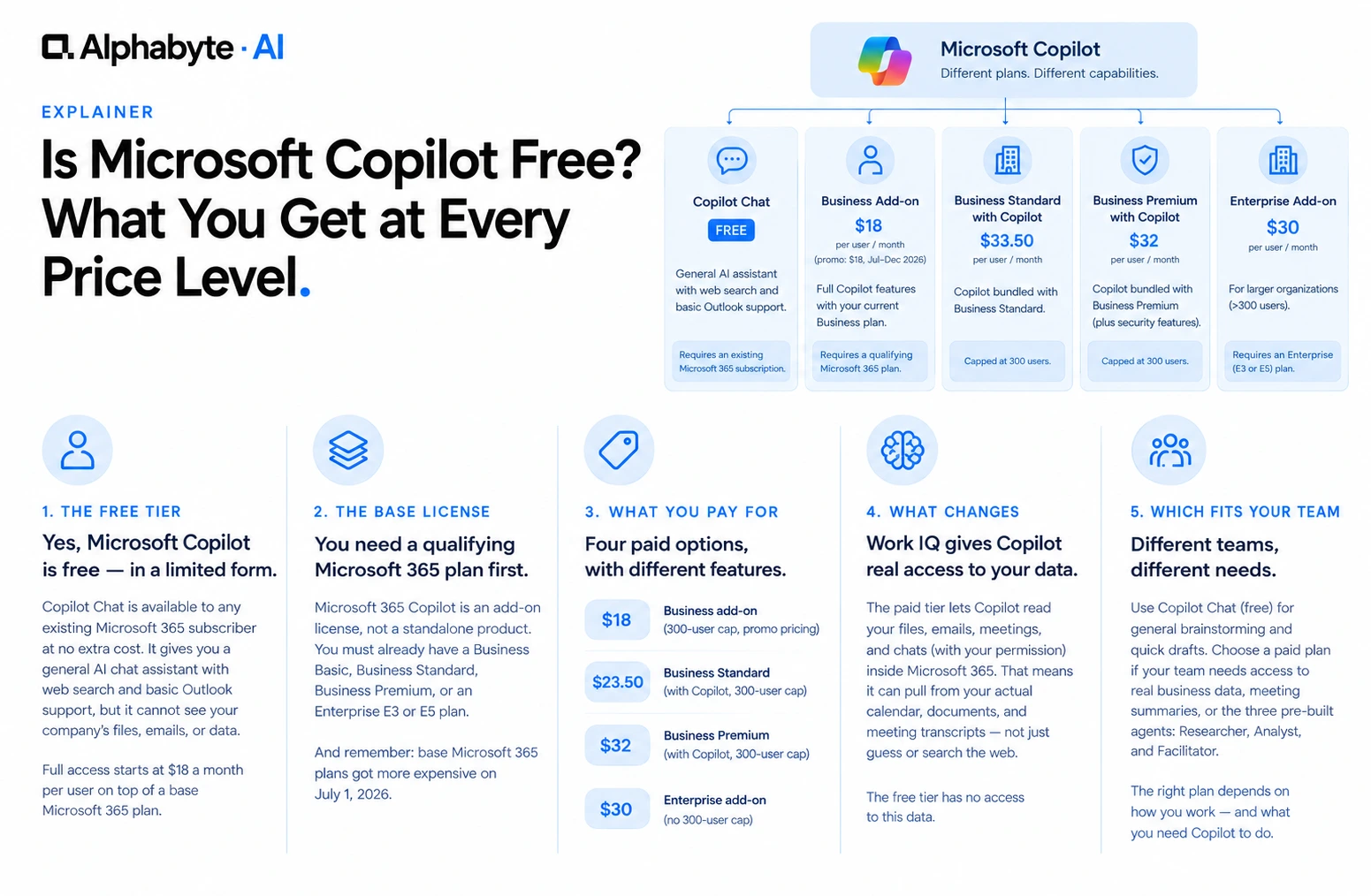
Is Microsoft Copilot Free? What You Get at Every Price Level
Microsoft Copilot has a free tier, but it is missing the one feature most businesses actually want. Here is what each price level actually includes, and what it requires underneath.
Read more →
What Is an MCP Server? A Plain-English Guide for Business Teams
MCP servers let AI tools like Copilot and Claude read your company's real data instead of guessing. Here is what that means, without the engineering jargon.
Read more →